


Page 961 - Hall et al (2015) Principles of Critical Care-McGraw-Hill
P. 961
692     PART 5: Infectious Disorders


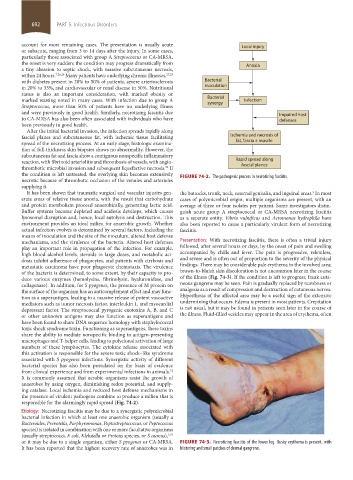
                 account  for  most  remaining  cases.  The  presentation  is  usually  acute   Local injury
                 or subacute, ranging from 3 to 14 days after the injury. In some cases,
                 particularly those associated with group A Streptococcus or CA-MRSA,
                 the onset is very sudden; the condition may progress dramatically from       Anoxia
                 a tiny abrasion to septic shock, with massive subcutaneous necrosis,
                 within 24 hours. 7,26,28  Many patients have underlying chronic illnesses, 27,29
                 with diabetes present in 20% to 50% of patients, severe arteriosclerosis   Bacterial
                 in 20% to 33%, and cardiovascular or renal disease in 50%. Nutritional   inoculation
                 status  is  also  an  important  consideration,  with  marked  obesity  or
                 marked wasting noted in many cases. With infection due to group A   Bacterial  Infection
                 Streptococcus, more than 50% of patients have no underlying illness   synergy
                 and were previously in good health. Similarly, necrotizing fasciitis due                Impaired host
                 to CA-MRSA has also been often associated with individuals who have                     defenses
                 been previously in good health.
                   After the initial bacterial invasion, the infection spreads rapidly along
                 fascial planes and subcutaneous fat, with ischemic tissue facilitating   Ischemia and necrosis of
                 spread of the necrotizing process. At an early stage, histologic examina-  fat, fascia ± muscle
                 tion of full-thickness skin biopsies shows no abnormality. However, the
                 subcutaneous fat and fascia show a contiguous nonspecific inflammatory
                 reaction, with fibrinoid arteriolitis and thrombosis of vessels, with angio-  Rapid spread along
                 thrombotic microbial invasion and subsequent liquefactive necrosis.  If    fascial planes
                                                                  31
                 the condition is left untreated, the overlying skin becomes extensively   FIGURE 74-2.  The pathogenic process in necrotizing fasciitis.
                 necrotic because of thrombotic occlusion of the venules and arterioles
                 supplying it.
                   It has been shown that traumatic surgical and vascular injuries gen-  the buttocks, trunk, neck, external genitalia, and inguinal areas.  In most
                                                                                                                    5
                 erate areas of relative tissue anoxia, with the result that carbohydrate   cases of polymicrobial origin, multiple organisms are present, with an
                 and protein metabolism proceed anaerobically, generating lactic acid.   average of three or four isolates per patient. Some investigators distin-
                 Buffer systems become depleted and acidosis develops, which causes   guish acute group A streptococcal or CA-MRSA necrotizing fasciitis
                 lysosomal disruption and, hence, local autolysis and destruction. This   as a separate entity.  Vibrio vulnificus and  Aeromonas hydrophila have
                 environment provides an ideal milieu for anaerobic growth. Whether   also been reported to cause a particularly virulent form of necrotizing
                 actual infection evolves is determined by several factors, including the   fasciitis.
                 means of inoculation and the size of the inoculum, altered host defense
                 mechanisms, and the virulence of the bacteria. Altered host defenses   Presentation:  With necrotizing fasciitis, there is often a trivial injury
                 play an important role in propagation of the infection. For example,   followed, after several hours or days, by the onset of pain and swelling
                 high blood alcohol levels, steroids in large doses, and metabolic aci-  accompanied by  chills and  fever. The pain  is progressive, relentless,
                 dosis inhibit adherence of phagocytes, and patients with cirrhosis and   and severe and is often out of proportion to the severity of the physical
                 metastatic carcinoma have poor phagocyte chemotaxis. The virulence   findings. There may be considerable pale erythema in the involved area;
                 of the bacteria is determined, to some extent, by their capacity to pro-  brown-to-bluish skin discoloration is not uncommon later in the course
                 duce various enzymes (hemolysins, fibrinolysin, hyaluronidase, and   of the illness (Fig. 74-3). If the condition is left to progress, frank cuta-
                 collagenase). In addition, for S pyogenes, the presence of M protein on   neous gangrene may be seen. Pain is gradually replaced by numbness or
                 the surface of the organism has an anticomplement effect and may func-  analgesia as a result of compression and destruction of cutaneous nerves.
                 tion as a superantigen, leading to a massive release of potent vasoactive   Hypesthesia of the affected area may be a useful sign of the extensive
                 mediators such as tumor necrosis factor, interleukin 1, and myocardial   undermining that occurs. Edema is present in most patients. Crepitation
                 depressant factor. The streptococcal pyrogenic exotoxins A, B, and C   is not usual, but it may be found in patients seen later in the course of
                 or other unknown antigens may also function as superantigens and   the illness. Fluid-filled vesicles may appear in the area of erythema, often
                 have been found to share DNA sequence homology with staphylococcal
                 toxic shock syndrome toxin. Functioning as superantigens, these toxins
                 share the ability to mediate nonspecific binding to antigen-presenting
                 macrophages and T-helper cells, leading to polyclonal activation of large
                 numbers  of  these  lymphocytes.  The  cytokine  release  associated  with
                 this activation is responsible for the severe toxic shock–like syndrome
                 associated with  S pyogenes infections. Synergistic activity of different
                 bacterial  species  has  also  been  postulated  on  the  basis  of  evidence
                 from clinical experience and from experimental infections in animals.
                                                                    32
                 It is commonly assumed that aerobic organisms assist the growth of
                 anaerobes by using oxygen, diminishing redox potential, and supply-
                 ing catalase. Local ischemia and reduced host defense mechanisms in
                 the presence of virulent pathogens combine to produce a milieu that is
                 responsible for the alarmingly rapid spread (Fig. 74-2).
                 Etiology:  Necrotizing fasciitis may be due to a synergistic polymicrobial
                 bacterial infection in which at least one anaerobic organism (usually a
                 Bacteroides, Prevotella, Porphyromonas, Peptostreptococcus, or Peptococcus
                 species) is isolated in combination with one or more facultative organisms
                 (usually streptococci, E coli, Klebsiella or Proteus species, or S aureus),
                                                                   5,33
                 or it may be due to a single organism, either S pyogenes or CA-MRSA.   FIGURE 74-3.  Necrotizing fasciitis of the lower leg. Dusky erythema is present, with
                 It has been reported that the highest recovery rate of anaerobes was in    blistering and small patches of dermal gangrene.


            section05_c74-81.indd   692                                                                                1/23/2015   12:37:22 PM

