


Page 958 - Hall et al (2015) Principles of Critical Care-McGraw-Hill
P. 958
CHAPTER 74: Soft Tissue Infections  689


                    of a classification of these entities is required, but, unfortunately, the   Normally, the skin has a resident and a transient flora. The resident
                    published literature in this area may be confusing because of a lack of   flora includes both bacteria and fungi but bacteria are most prevalent.
                    uniformity in descriptive terminology and the use of different classifi-  The gram-positive cocci, including corynebacteria, propionibacteria,
                    cation schemes. The confusion is compounded by the fact that certain   coagulase-negative staphylococci, Micrococcus, streptococci, lactococci,
                    clinical entities may involve one or more anatomic planes within the   and Bacillus make up over 75% of the skin flora. Certain areas of the
                    subcutaneous tissue, and one or more bacterial species may be respon-  body such as the buttocks, perineum, fossae and web spaces between
                    sible for the same or different clinical entities. Although classification   the digits contain a more diverse flora and some gram-negative bacte-
                    schemes based on microbial etiology may be the most complete, they   ria may be found including Acinetobacter, Serratia, Pseudomonas, and
                    offer little to the clinical diagnostic process necessary to expedite appro-  occasionally anaerobic gram-negative bacteria.  Staphylococcus aureus
                                                                                                            3,4
                    priate  management.  To place a useful clinicoanatomic classification into   is  not considered part of  the  resident flora,  but colonization rates  of
                                  1
                    perspective, a review of the basic anatomy and microbial ecology of the   10% to 30% in the anterior nares, axillae, groins, and perineum are not
                    skin and subcutaneous tissues is necessary.           uncommon. The transient flora is made up of bacteria that are collected
                        ■  ANATOMY AND MICROBIAL ECOLOGY OF THE SKIN AND SOFT TISSUES  from extraneous sources and colonize the cutaneous surface for only a
                                                                          short period (hours to days). These organisms are highly variable but
                    The skin consists of an outer layer, the epidermis, and an inner layer, the   often include pathogenic gram-negative bacilli such as Escherichia coli,
                                                                                                                      5
                    dermis, which resides on a fibrous connective tissue layer, the superficial   Proteus species, Klebsiella-Enterobacter species, among others.  Critically
                    fascia. Beneath this layer, the avascular deep fascia overlies and separates   ill patients frequently have compromised natural defense barriers, with
                    muscle groups and acts as a mechanical barrier against the spread of   concomitant increases in transient flora colonization. 6
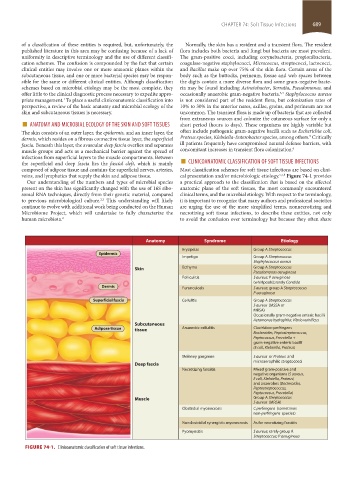
                    the superficial and deep fascia lies the  fascial cleft, which is mainly   ■  CLINICOANATOMIC CLASSIFICATION OF SOFT TISSUE INFECTIONS
                    infections from superficial layers to the muscle compartments. Between
                    composed of adipose tissue and contains the superficial nerves, arteries,   Most classification schemes for soft tissue infections are based on clini-
                    veins, and lymphatics that supply the skin and adipose tissue.  cal presentation and/or microbiologic etiology. 5,7,8  Figure 74-1 provides
                     Our understanding of the numbers and types of microbial species   a practical approach to the classification that is based on the affected
                    present on the skin has significantly changed with the use of 16S ribo-  anatomic  plane of the  soft  tissues,  the most commonly encountered
                    somal RNA techniques, directly from their genetic material, compared   clinical terms, and the microbial etiology. With respect to the terminology,
                    to previous microbiological culture.  This understanding will likely   it is important to recognize that many authors and professional societies
                                              2,3
                    continue to evolve with additional work being conducted on the Human   are  urging  the  use  of  the  more  simplified  terms,  nonnecrotizing  and
                    Microbiome Project, which will undertake to fully characterize the   necrotizing soft tissue infections, to describe these entities, not only
                    human microbiota. 2                                   to avoid the confusion over terminology but because they often share


                                                              Anatomy             Syndrome                  Etiology
                                                                          Erysipelas               Group A Streptococcus
                                              Epidermis
                                                                          Impetigo                 Group A Streptococcus
                                                                                                   Staphylococcus aureus
                                                          Skin            Ecthyma                  Group A Streptococcus
                                                                                                   Pseudomonas aeruginosa
                                                                          Folliculitis             S aureus; P aeruginosa
                                                                                                   (whirlpools); rarely Candida
                                               Dermis                     Furunculosis             S aureus; group A Streptococcus
                                                                                                   P aeruginosa
                                            Superficial fascia            Cellulitis               Group A Streptococcus
                                                                                                   S aureus  (MSSA or
                                                                                                   MRSA)
                                                                                                   Occasionally gram-negative enteric bacilli
                                                                                                   Aeromonas hydrophila; Vibrio vulnificus
                                                          Subcutaneous
                                            Adipose tissue  tissue        Anaerobic cellulitis     Clostridium perfringens
                                                                                                   Bacteroides, Peptostreptococcus,
                                                                                                   Peptococcus, Prevotella +
                                                                                                   gram-negative enteric bacilli
                                                                                                   (E coli, Klebsiella, Proteus)
                                                                          Meleney gangrene         S aureus  or Proteus  and
                                                                                                   microaerophilic streptococci
                                                          Deep fascia
                                                                          Necrotizing fasciitis    Mixed gram-positive and
                                                                                                   negative organisms (S aureus,
                                                                                                   E coli, Klebsiella, Proteus)
                                                                                                   and anaerobes (Bacteroides,
                                                                                                   Peptostreptococcus,
                                                                                                   Peptococcus, Prevotella)
                                                          Muscle                                   Group A Streptococcus
                                                                                                   S aureus  (MRSA)
                                                                          Clostridial myonecrosis  C perfringens  (sometimes
                                                                                                   non-perfringens  species)
                                                                          Nonclostridial synergistic myonecrosis  As for necrotizing fasciitis
                                                                          Pyomyositis              S aureus; rarely group A
                                                                                                   Streptococcus; P aeruginosa
                     FIGURE 74-1.  Clinicoanatomic classification of soft tissue infections.


            section05_c74-81.indd   689                                                                                1/23/2015   12:37:20 PM

