


Page 147 - Psychology of Wounds and Wound Care in Clinical Practice ( PDFDrive )
P. 147
122  Chapter 5.  Different Wound Type

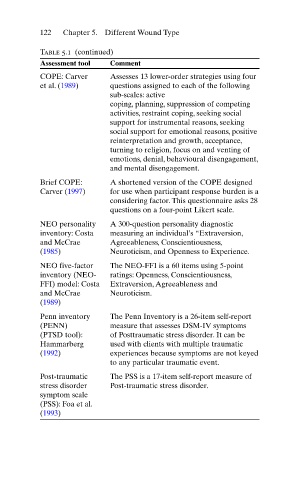
           Table 5.1 (continued)
            Assessment tool    Comment
            COPE: Carver     Assesses 13 lower-order strategies using four
           et al. (  1989 )   questions assigned to each of the following
                           sub-scales: active
                             coping, planning, suppression of competing
                           activities, restraint coping, seeking social
                           support for instrumental reasons, seeking
                           social support for emotional reasons, positive
                           reinterpretation and growth, acceptance,
                           turning to religion, focus on and venting of
                           emotions, denial, behavioural disengagement,
                           and mental disengagement.
            Brief COPE:      A shortened version of the COPE designed
           Carver (  1997 )   for use when participant response burden is a
                           considering factor. This questionnaire asks 28
                           questions on a four-point Likert scale.
               NEO personality     A 300-question personality diagnostic
           inventory: Costa   measuring an individual’s “Extraversion,
           and McCrae      Agreeableness, Conscientiousness,
           (  1985 )       Neuroticism, and Openness to Experience.
               NEO five- factor     The NEO-FFI is a 60 items using 5-point
           inventory (NEO-  ratings: Openness, Conscientiousness,
           FFI) model: Costa   Extraversion, Agreeableness and
           and McCrae      Neuroticism.
           (  1989 )
            Penn inventory     The Penn Inventory is a 26-item self-report
           (PENN)          measure that assesses DSM-IV symptoms
           (PTSD tool):    of Posttraumatic stress disorder. It can be
           Hammarberg      used with clients with multiple traumatic
           (  1992 )       experiences because symptoms are not keyed
                           to any particular traumatic event.
            Post-traumatic     The PSS is a 17-item self-report measure of
           stress disorder   Post-traumatic stress disorder.
           symptom scale
           (PSS): Foa et al.
           (  1993 )

