


Page 148 - Psychology of Wounds and Wound Care in Clinical Practice ( PDFDrive )
P. 148
Diabetic Foot Ulcer (DFU)  123

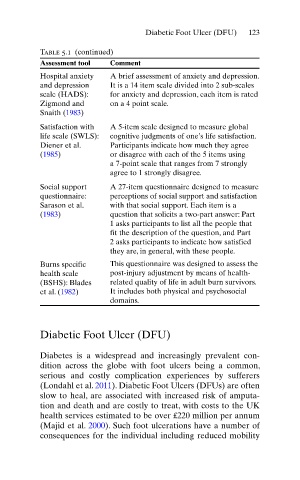
           Table 5.1 (continued)
            Assessment tool    Comment
            Hospital anxiety     A brief assessment of anxiety and depression.
           and depression   It is a 14 item scale divided into 2 sub-scales
           scale (HADS):   for anxiety and depression, each item is rated
           Zigmond and     on a 4 point scale.
           Snaith (  1983 )

            Satisfaction with     A 5-item scale designed to measure global
           life scale (SWLS):   cognitive judgments of one’s life satisfaction.
           Diener et al.   Participants indicate how much they agree
           (  1985 )       or disagree with each of the 5 items using
                           a 7-point scale that ranges from 7 strongly
                           agree to 1 strongly disagree.
            Social support     A 27-item questionnaire designed to measure
           questionnaire:   perceptions of social support and satisfaction
           Sarason et al.   with that social support. Each item is a
           (  1983 )       question that solicits a two-part answer: Part
                           1 asks participants to list all the people that
                           fit the description of the question, and Part
                           2 asks participants to indicate how satisfied
                           they are, in general, with these people.
            Burns specific     This questionnaire was designed to assess the
           health scale    post-injury adjustment by means of health-
           (BSHS): Blades   related quality of life in adult burn survivors.
           et al. (  1982 )   It includes both physical and psychosocial
                           domains.


               Diabetic Foot Ulcer (DFU)

            Diabetes is a widespread and increasingly prevalent con-
           dition across the globe with foot ulcers being a common,
           serious and costly complication experiences by sufferers
           (Londahl et al.   2011 ). Diabetic Foot Ulcers (DFUs) are often
           slow to heal, are associated with increased risk of amputa-
           tion and death and are costly to treat, with costs to the UK
           health services estimated to be over £220 million per annum
           (Majid et al.   2000 ). Such foot ulcerations have a number of
           consequences for the individual including reduced mobility

