


Page 100 - Clinical Anatomy
P. 100
ECA2  7/18/06  6:42 PM  Page 85


                                                                    The gastrointestinal tract  85


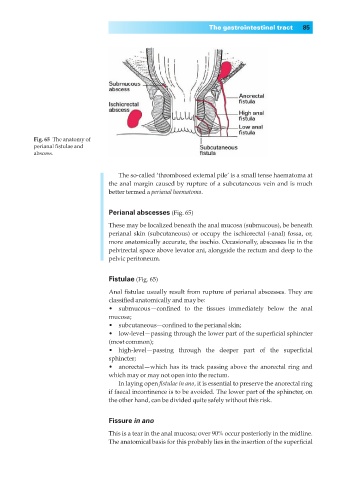
                  Fig. 65◊The anatomy of
                  perianal fistulae and
                  abscess.


                                          The so-called ‘thrombosed external pile’ is a small tense haematoma at
                                        the anal margin caused by rupture of a subcutaneous vein and is much
                                        better termed a perianal haematoma.


                                        Perianal abscesses (Fig. 65)
                                        These may be localized beneath the anal mucosa (submucous), be beneath
                                        perianal skin (subcutaneous) or occupy the ischiorectal (-anal) fossa, or,
                                        more anatomically accurate, the isschio. Occasionally, abscesses lie in the
                                        pelvirectal space above levator ani, alongside the rectum and deep to the
                                        pelvic peritoneum.


                                        Fistulae (Fig. 65)
                                        Anal fistulae usually result from rupture of perianal abscesses. They are
                                        classified anatomically and may be:
                                        •◊◊submucous —confined to the tissues immediately below the anal
                                        mucosa;
                                        •◊◊subcutaneous—confined to the perianal skin;
                                        •◊◊low-level— passing through the lower part of the superficial sphincter
                                        (most common);
                                        •◊◊high-level—passing through the deeper part of the superficial
                                        sphincter;
                                        •◊◊anorectal —which has its track passing above the anorectal ring and
                                        which may or may not open into the rectum.
                                          In laying open fistulae in ano, it is essential to preserve the anorectal ring
                                        if faecal incontinence is to be avoided. The lower part of the sphincter, on
                                        the other hand, can be divided quite safely without this risk.


                                        Fissure in ano
                                        This is a tear in the anal mucosa; over 90% occur posteriorly in the midline.
                                        The anatomical basis for this probably lies in the insertion of the superficial

