


Page 229 - Clinical Anatomy
P. 229
ECA4  7/18/06  6:47 PM  Page 214


                 214  The lower limb


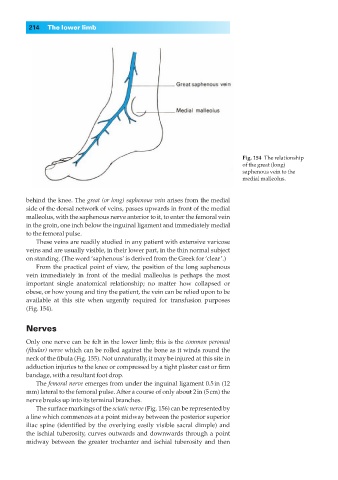
                                                                              Fig. 154◊The relationship
                                                                              of the great (long)
                                                                              saphenous vein to the
                                                                              medial malleolus.


                behind the knee. The great (or long) saphenous vein arises from the medial
                side of the dorsal network of veins, passes upwards in front of the medial
                malleolus, with the saphenous nerve anterior to it, to enter the femoral vein
                in the groin, one inch below the inguinal ligament and immediately medial
                to the femoral pulse.
                   These veins are readily studied in any patient with extensive varicose
                veins and are usually visible, in their lower part, in the thin normal subject
                on standing. (The word ‘saphenous’ is derived from the Greek for ‘clear’.)
                   From the practical point of view, the position of the long saphenous
                vein immediately in front of the medial malleolus is perhaps the most
                important single anatomical relationship; no matter how collapsed or
                obese, or how young and tiny the patient, the vein can be relied upon to be
                available at this site when urgently required for transfusion purposes
                (Fig. 154).

                Nerves

                Only one nerve can be felt in the lower limb; this is the common peroneal
                (fibular) nerve which can be rolled against the bone as it winds round the
                neck of the fibula (Fig. 155). Not unnaturally, it may be injured at this site in
                adduction injuries to the knee or compressed by a tight plaster cast or firm
                bandage, with a resultant foot drop.
                   The femoral nerve emerges from under the inguinal ligament 0.5in (12
                mm) lateral to the femoral pulse. After a course of only about 2in (5cm) the
                nerve breaks up into its terminal branches.
                   The surface markings of the sciatic nerve (Fig. 156) can be represented by
                a line which commences at a point midway between the posterior superior
                iliac spine (identified by the overlying easily visible sacral dimple) and
                the ischial tuberosity, curves outwards and downwards through a point
                midway between the greater trochanter and ischial tuberosity and then

