


Page 281 - Clinical Anatomy
P. 281
ECA5  7/18/06  6:50 PM  Page 266


                 266  The head and neck


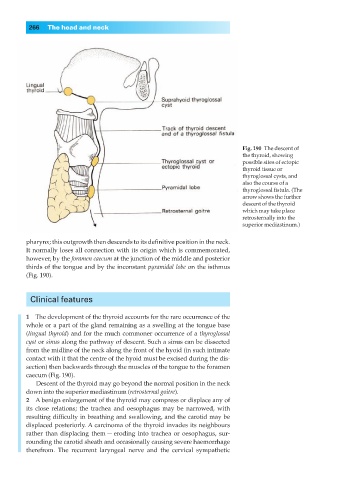
                                                                              Fig. 190◊The descent of
                                                                              the thyroid, showing
                                                                              possible sites of ectopic
                                                                              thyroid tissue or
                                                                              thyroglossal cysts, and
                                                                              also the course of a
                                                                              thyroglossal fistula. (The
                                                                              arrow shows the further
                                                                              descent of the thyroid
                                                                              which may take place
                                                                              retrosternally into the
                                                                              superior mediastinum.)


                pharynx; this outgrowth then descends to its definitive position in the neck.
                It normally loses all connection with its origin which is commemorated,
                however, by the foramen caecum at the junction of the middle and posterior
                thirds of the tongue and by the inconstant pyramidal lobe on the isthmus
                (Fig. 190).


                 Clinical features

                1◊◊The development of the thyroid accounts for the rare occurrence of the
                whole or a part of the gland remaining as a swelling at the tongue base
                (lingual thyroid) and for the much commoner occurrence of a thyroglossal
                cyst or sinus along the pathway of descent. Such a sinus can be dissected
                from the midline of the neck along the front of the hyoid (in such intimate
                contact with it that the centre of the hyoid must be excised during the dis-
                section) then backwards through the muscles of the tongue to the foramen
                caecum (Fig. 190).
                   Descent of the thyroid may go beyond the normal position in the neck
                down into the superior mediastinum (retrosternal goitre).
                2◊◊A benign enlargement of the thyroid may compress or displace any of
                its close relations; the trachea and oesophagus may be narrowed, with
                resulting difficulty in breathing and swallowing, and the carotid may be
                displaced posteriorly. A carcinoma of the thyroid invades its neighbours
                rather than displacing them — eroding into trachea or oesophagus, sur-
                rounding the carotid sheath and occasionally causing severe haemorrhage
                therefrom. The recurrent laryngeal nerve and the cervical sympathetic

