


Page 286 - Clinical Anatomy
P. 286
ECA5  7/18/06  6:50 PM  Page 271


                                                                                  The palate   271


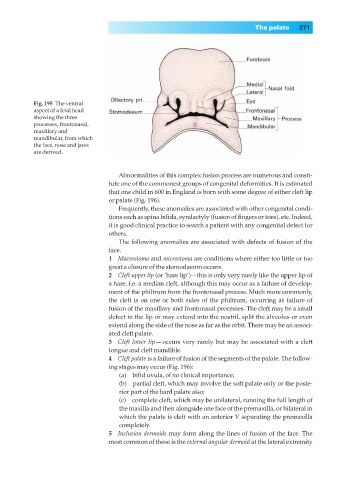
                  Fig. 195◊The ventral
                  aspect of a fetal head
                  showing the three
                  processes, frontonasal,
                  maxillary and
                  mandibular, from which
                  the face, nose and jaws
                  are derived.


                                          Abnormalities of this complex fusion process are numerous and consti-
                                       tute one of the commonest groups of congenital deformities. It is estimated
                                       that one child in 600 in England is born with some degree of either cleft lip
                                       or palate (Fig. 196).
                                          Frequently, these anomalies are associated with other congenital condi-
                                       tions such as spina bifida, syndactyly (fusion of fingers or toes), etc. Indeed,
                                       it is good clinical practice to search a patient with any congenital defect for
                                       others.
                                          The following anomalies are associated with defects of fusion of the
                                       face.
                                       1◊◊Macrostoma and microstoma are conditions where either too little or too
                                       great a closure of the stomodaeum occurs.
                                       2◊◊Cleft upper lip (or ‘hare lip’)—this is only very rarely like the upper lip of
                                       a hare, i.e. a median cleft, although this may occur as a failure of develop-
                                       ment of the philtrum from the frontonasal process. Much more commonly,
                                       the cleft is on one or both sides of the philtrum, occurring as failure of
                                       fusion of the maxillary and frontonasal processes. The cleft may be a small
                                       defect in the lip or may extend into the nostril, split the alveolus or even
                                       extend along the side of the nose as far as the orbit. There may be an associ-
                                       ated cleft palate.
                                       3◊◊Cleft lower lip — occurs very rarely but may be associated with a cleft
                                       tongue and cleft mandible.
                                       4◊◊Cleft palate is a failure of fusion of the segments of the palate. The follow-
                                       ing stages may occur (Fig. 196):
                                           (a)  bifid uvula, of no clinical importance;
                                           (b)  partial cleft, which may involve the soft palate only or the poste-
                                           rior part of the hard palate also;
                                           (c)  complete cleft, which may be unilateral, running the full length of
                                           the maxilla and then alongside one face of the premaxilla, or bilateral in
                                           which the palate is cleft with an anterior V separating the premaxilla
                                           completely.
                                       5◊◊Inclusion dermoids may form along the lines of fusion of the face. The
                                       most common of these is the external angular dermoid at the lateral extremity

