


Page 282 - Clinical Anatomy
P. 282
ECA5  7/18/06  6:50 PM  Page 267


                                                                           The thyroid gland   267


                                       chain may be involved, producing changes in the voice and Horner’s syn-
                                       drome respectively.
                                       3◊◊We have already noted, in dealing with the fasciae of the neck, that the
                                       thyroid gland is enclosed in the pretracheal fascia. This thyroid capsule is
                                       much denser in front than behind and the enlarging gland therefore tends
                                       to push backwards, burying itself round the sides and even the back of the
                                       trachea and oesophagus. Because of the attachments of its fascial com-
                                       partment, a large goitre will also extend downwards into the superior
                                       mediastinum (‘plunging goitre’).
                                          Above, the pretracheal fascia blends with the larynx, accounting for the
                                       upward movement of the thyroid gland with each act of swallowing.
                                       4◊◊Thyroidectomy is carried out through a transverse ‘collar’ incision, two
                                       fingers’ breadth above the suprasternal notch. This lies in the line of the
                                       natural skin folds of the neck. Skin flaps are reflected, together with
                                       platysma, and the investing fascia opened longitudinally between the strap
                                       muscles and between the anterior jugular veins.
                                          If more room is required in the case of a large goitre, the strap muscles
                                       are divided; this is carried out at their upper extremity because their nerve
                                       supply (the ansa hypoglossi) enters the lower part of the muscles and is
                                       hence preserved.
                                          The pretracheal fascia is then divided, exposing the thyroid gland;
                                       unless this tissue plane deep to the fascia is found, dissection is a difficult
                                       and bloody procedure.
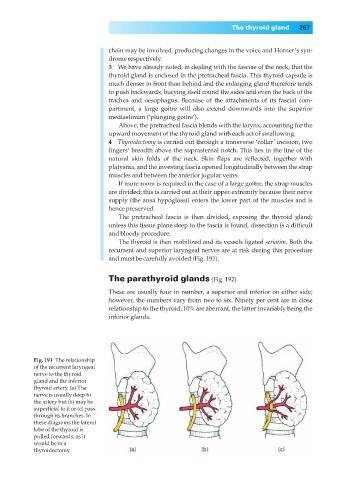
                                          The thyroid is then mobilized and its vessels ligated seriatim. Both the
                                        recurrent and superior laryngeal nerves are at risk during this procedure
                                        and must be carefully avoided (Fig. 191).


                                       The parathyroid glands (Fig. 192)
                                        These are usually four in number, a superior and inferior on either side;
                                        however, the numbers vary from two to six. Ninety per cent are in close
                                        relationship to the thyroid, 10% are aberrant, the latter invariably being the
                                        inferior glands.


                  Fig. 191◊The relationship
                  of the recurrent laryngeal
                  nerve to the thyroid
                  gland and the inferior
                  thyroid artery. (a) The
                  nerve is usually deep to
                  the artery but (b) may be
                  superficial to it or (c) pass
                  through its branches. In
                  these diagrams the lateral
                  lobe of the thyroid is
                  pulled forwards, as it
                  would be in a
                  thyroidectomy.

