


Page 30 - Clinical Anatomy
P. 30
ECA1  7/18/06  6:31 PM  Page 15


                                                                            The thoracic cage   15


                             Oesophagus

                         Inferior vena cava
                                                                                     Left phrenic nerve
                        Right phrenic nerve                                          Vagi


                          Right splanchnic                                           Aorta
                                   nerve                                             Left splanchnic
                                                                                     nerve

                                                                                     Subcostal nerve
                      Transverse abdominis
                                 muscle
                      Quadratus lumborum
                                 muscle                                      Sympathetic trunk
                             Psoas major
                                 muscle

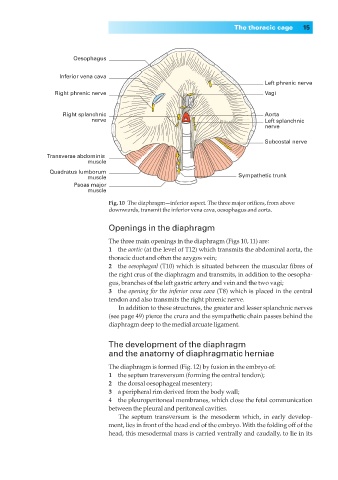
                                        Fig. 10◊The diaphragm—inferior aspect. The three major orifices, from above
                                        downwards, transmit the inferior vena cava, oesophagus and aorta.

                                       Openings in the diaphragm
                                       The three main openings in the diaphragm (Figs 10, 11) are:
                                       1◊◊the aortic (at the level of T12) which transmits the abdominal aorta, the
                                       thoracic duct and often the azygos vein;
                                       2◊◊the oesophageal (T10) which is situated between the muscular fibres of
                                       the right crus of the diaphragm and transmits, in addition to the oesopha-
                                       gus, branches of the left gastric artery and vein and the two vagi;
                                       3◊◊the opening for the inferior vena cava (T8) which is placed in the central
                                       tendon and also transmits the right phrenic nerve.
                                          In addition to these structures, the greater and lesser splanchnic nerves
                                       (see page 49) pierce the crura and the sympathetic chain passes behind the
                                       diaphragm deep to the medial arcuate ligament.


                                       The development of the diaphragm
                                       and the anatomy of diaphragmatic herniae
                                       The diaphragm is formed (Fig. 12) by fusion in the embryo of:
                                       1◊◊the septum transversum (forming the central tendon);
                                       2◊◊the dorsal oesophageal mesentery;
                                       3◊◊a peripheral rim derived from the body wall;
                                       4◊◊the pleuroperitoneal membranes, which close the fetal communication
                                       between the pleural and peritoneal cavities.
                                          The septum transversum is the mesoderm which, in early develop-
                                       ment, lies in front of the head end of the embryo. With the folding off of the
                                       head, this mesodermal mass is carried ventrally and caudally, to lie in its

