


Page 32 - Clinical Anatomy
P. 32
ECA1  7/18/06  6:31 PM  Page 17


                                                                            The thoracic cage   17


                                       definitive position at the anterior part of the diaphragm. During this migra-
                                       tion, the cervical myotomes and nerves contribute muscle and nerve
                                       supply respectively, thus accounting for the long course of the phrenic
                                       nerve (C3, 4 and 5) from the neck to the diaphragm.
                                          With such a complex embryological story, one may be surprised to
                                        know that congenital abnormalities of the diaphragm are unusual.
                                          However, a number of defects may occur, giving rise to a variety of con-
                                        genital herniae through the diaphragm. These may be:
                                        1◊◊through the foramen of Morgagni; anteriorly between the xiphoid and
                                        costal origins;
                                        2◊◊through the foramen of Bochdalek— the pleuroperitoneal canal— lying
                                        posteriorly;
                                        3◊◊through a deficiency of the whole central tendon (occasionally such a
                                        hernia may be traumatic in origin);
                                        4◊◊through a congenitally large oesophageal hiatus.
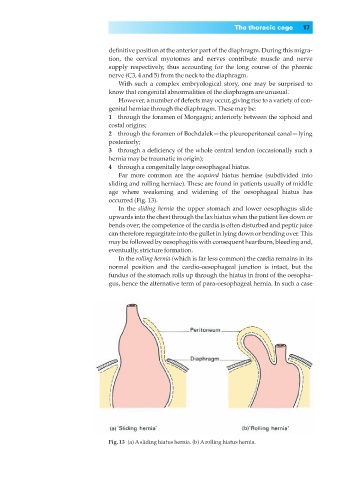
                                          Far more common are the  acquired hiatus herniae (subdivided into
                                        sliding and rolling herniae). These are found in patients usually of middle
                                        age where weakening and widening of the oesophageal hiatus has
                                        occurred (Fig. 13).
                                          In the  sliding hernia the upper stomach and lower oesophagus slide
                                        upwards into the chest through the lax hiatus when the patient lies down or
                                        bends over; the competence of the cardia is often disturbed and peptic juice
                                        can therefore regurgitate into the gullet in lying down or bending over. This
                                        may be followed by oesophagitis with consequent heartburn, bleeding and,
                                        eventually, stricture formation.
                                          In the rolling hernia (which is far less common) the cardia remains in its
                                        normal position and the cardio-oesophageal junction is intact, but the
                                        fundus of the stomach rolls up through the hiatus in front of the oesopha-
                                        gus, hence the alternative term of para-oesophageal hernia. In such a case


                                        Fig. 13◊(a) Asliding hiatus hernia. (b) Arolling hiatus hernia.

