


Page 302 - Clinical Anatomy
P. 302
ECA5  7/18/06  6:50 PM  Page 287


                                                                                  The larynx   287


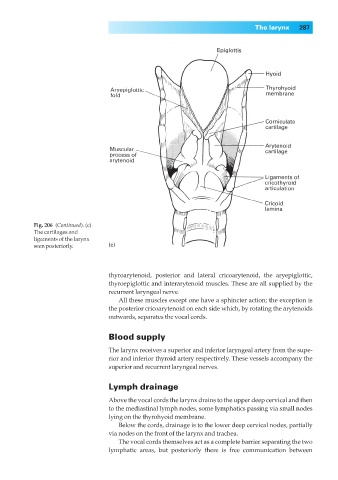
                  Fig. 206◊(Continued). (c)
                  The cartilages and
                  ligaments of the larynx
                  seen posteriorly.     (c)


                                       thyroarytenoid, posterior and lateral cricoarytenoid, the aryepiglottic,
                                       thyroepiglottic and interarytenoid muscles. These are all supplied by the
                                       recurrent laryngeal nerve.
                                          All these muscles except one have a sphincter action; the exception is
                                       the posterior cricoarytenoid on each side which, by rotating the arytenoids
                                       outwards, separates the vocal cords.

                                       Blood supply

                                       The larynx receives a superior and inferior laryngeal artery from the supe-
                                       rior and inferior thyroid artery respectively. These vessels accompany the
                                       superior and recurrent laryngeal nerves.


                                       Lymph drainage
                                       Above the vocal cords the larynx drains to the upper deep cervical and then
                                       to the mediastinal lymph nodes, some lymphatics passing via small nodes
                                       lying on the thyrohyoid membrane.
                                          Below the cords, drainage is to the lower deep cervical nodes, partially
                                       via nodes on the front of the larynx and trachea.
                                          The vocal cords themselves act as a complete barrier separating the two
                                       lymphatic areas, but posteriorly there is free communication between

