


Page 305 - Clinical Anatomy
P. 305
ECA5  7/18/06  6:50 PM  Page 290


                 290  The head and neck


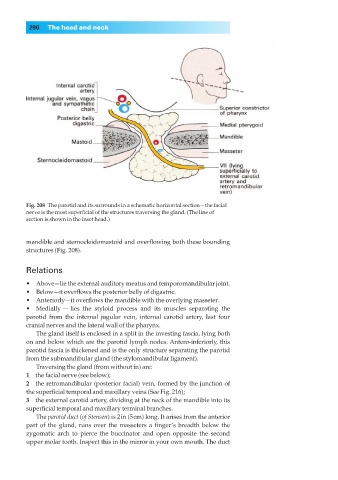
                Fig. 208◊The parotid and its surrounds in a schematic horizontal section—the facial
                nerve is the most superficial of the structures traversing the gland. (The line of
                section is shown in the inset head.)


                mandible and sternocleidomastoid and overflowing both these bounding
                structures (Fig. 208).

                Relations

                •◊◊Above—lie the external auditory meatus and temporomandibular joint.
                •◊◊Below—it overflows the posterior belly of digastric.
                •◊◊Anteriorly—it overflows the mandible with the overlying masseter.
                •◊◊Medially — lies the styloid process and its muscles separating the
                parotid from the internal jugular vein, internal carotid artery, last four
                cranial nerves and the lateral wall of the pharynx.
                   The gland itself is enclosed in a split in the investing fascia, lying both
                on and below which are the parotid lymph nodes. Antero-inferiorly, this
                parotid fascia is thickened and is the only structure separating the parotid
                from the submandibular gland (the stylomandibular ligament).
                   Traversing the gland (from without in) are:
                1◊◊the facial nerve (see below);
                2◊◊the retromandibular (posterior facial) vein, formed by the junction of
                the superficial temporal and maxillary veins (See Fig. 216);
                3◊◊the external carotid artery, dividing at the neck of the mandible into its
                superficial temporal and maxillary terminal branches.
                   The parotid duct (of Stensen) is 2in (5cm) long. It arises from the anterior
                part of the gland, runs over the masseters a finger’s breadth below the
                zygomatic arch to pierce the buccinator and open opposite the second
                upper molar tooth. Inspect this in the mirror in your own mouth. The duct

