


Page 301 - Clinical Anatomy
P. 301
ECA5  7/18/06  6:50 PM  Page 286


                 286  The head and neck


                        Epiglottis
                                                       Hyo-epiglottic
                                                       ligament
                 Lateral thyrohyoid
                        ligament                       Hyoid

                                                       Median thyrohyoid
                                                       ligament
                Arytenoid cartilage
                                                       Vestibular fold
                       Vocal and                       Sinus of larynx
                muscular processes
                      of arytenoid                     Vocal fold
                                                       Cricovocal membrane
                                                       Cricothyroid ligament
                   Facet on cricoid
                   for inferior horn
                of thyroid cartilage
                                                       Cricotracheal ligament


                (a)


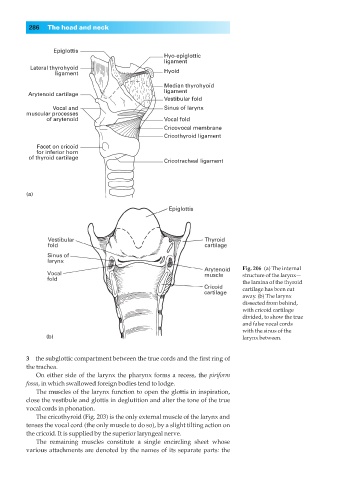
                                                                              Fig. 206◊(a) The internal
                                                                              structure of the larynx—
                                                                              the lamina of the thyroid
                                                                              cartilage has been cut
                                                                              away. (b) The larynx
                                                                              dissected from behind,
                                                                              with cricoid cartilage
                                                                              divided, to show the true
                                                                              and false vocal cords
                                                                              with the sinus of the
                     (b)                                                      larynx between.

                3◊◊the subglottic compartment between the true cords and the first ring of
                the trachea.
                   On either side of the larynx the pharynx forms a recess, the piriform
                fossa, in which swallowed foreign bodies tend to lodge.
                   The muscles of the larynx function to open the glottis in inspiration,
                close the vestibule and glottis in deglutition and alter the tone of the true
                vocal cords in phonation.
                   The cricothyroid (Fig. 203) is the only external muscle of the larynx and
                tenses the vocal cord (the only muscle to do so), by a slight tilting action on
                the cricoid. It is supplied by the superior laryngeal nerve.
                   The remaining muscles constitute a single encircling sheet whose
                various attachments are denoted by the names of its separate parts: the

