


Page 306 - Clinical Anatomy
P. 306
ECA5  7/18/06  6:50 PM  Page 291


                                                                         The salivary glands   291


                                       can easily be felt by a finger rolled over the masseter if this muscle is tensed
                                       by clenching the teeth.


                                       The relations of the facial nerve to the parotid
                                       The facial nerve is unique in traversing the substance of a gland, a fact of
                                       considerable importance to the surgeon. This coexistence is explained
                                       embryologically; the parotid gland develops in the crotch formed by the
                                       two major branches of the facial nerve. As the gland enlarges it overlaps
                                       these nerve trunks, the superficial and deep parts fuse and the nerve comes
                                       to lie buried within the gland. The fanciful comparison between the nerve
                                       and the two parotid lobes and sandwich–filling between two slices of bread
                                       is not valid because the two lobes of the parotid come to fuse intimately
                                       with each other both around and between the branches of the nerve.
                                          The facial nerve emerges from the stylomastoid foramen, winds later-
                                       ally to the styloid process and can then be exposed surgically in the
                                       inverted V between the bony part of the external auditory meatus and the
                                       mastoid process. This has a useful surface marking, the intertragic notch of
                                       the ear, which is situated directly over the facial nerve.
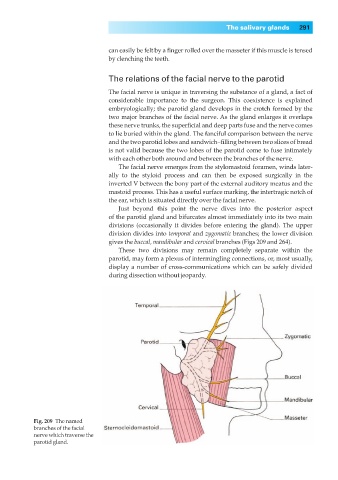
                                          Just beyond this point the nerve dives into the posterior aspect
                                       of the parotid gland and bifurcates almost immediately into its two main
                                       divisions (occasionally it divides before entering the gland). The upper
                                       division divides into temporal and zygomatic branches; the lower division
                                        gives the buccal, mandibular and cervical branches (Figs 209 and 264).
                                          These two divisions may remain completely separate within the
                                        parotid, may form a plexus of intermingling connections, or, most usually,
                                        display a number of cross-communications which can be safely divided
                                        during dissection without jeopardy.


                  Fig. 209◊The named
                  branches of the facial
                  nerve which traverse the
                  parotid gland.

