


Page 304 - Clinical Anatomy
P. 304
ECA5  7/18/06  6:50 PM  Page 289


                                                                         The salivary glands   289


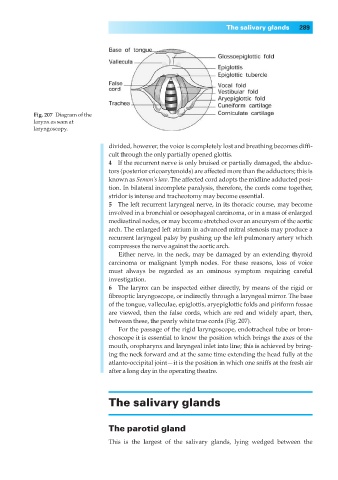
                  Fig. 207◊Diagram of the
                  larynx as seen at
                  laryngoscopy.

                                       divided, however, the voice is completely lost and breathing becomes diffi-
                                       cult through the only partially opened glottis.
                                       4◊◊If the recurrent nerve is only bruised or partially damaged, the abduc-
                                       tors (posterior cricoarytenoids) are affected more than the adductors; this is
                                       known as Semon’s law. The affected cord adopts the midline adducted posi-
                                        tion. In bilateral incomplete paralysis, therefore, the cords come together,
                                        stridor is intense and tracheotomy may become essential.
                                        5◊◊The left recurrent laryngeal nerve, in its thoracic course, may become
                                        involved in a bronchial or oesophageal carcinoma, or in a mass of enlarged
                                        mediastinal nodes, or may become stretched over an aneurysm of the aortic
                                        arch. The enlarged left atrium in advanced mitral stenosis may produce a
                                        recurrent laryngeal palsy by pushing up the left pulmonary artery which
                                        compresses the nerve against the aortic arch.
                                          Either nerve, in the neck, may be damaged by an extending thyroid
                                        carcinoma or malignant lymph nodes. For these reasons, loss of voice
                                        must always be regarded as an ominous symptom requiring careful
                                        investigation.
                                        6◊◊The larynx can be inspected either directly, by means of the rigid or
                                        fibreoptic laryngoscope, or indirectly through a laryngeal mirror. The base
                                        of the tongue, valleculae, epiglottis, aryepiglottic folds and piriform fossae
                                        are viewed, then the false cords, which are red and widely apart, then,
                                        between these, the pearly white true cords (Fig. 207).
                                          For the passage of the rigid laryngoscope, endotracheal tube or bron-
                                        choscope it is essential to know the position which brings the axes of the
                                        mouth, oropharynx and laryngeal inlet into line; this is achieved by bring-
                                        ing the neck forward and at the same time extending the head fully at the
                                        atlanto-occipital joint— it is the position in which one sniffs at the fresh air
                                       after a long day in the operating theatre.


                                       The salivary glands


                                       The parotid gland

                                       This is the largest of the salivary glands, lying wedged between the

