


Page 328 - Clinical Anatomy
P. 328
ECA5  7/18/06  6:51 PM  Page 313


                                                                                   The scalp   313


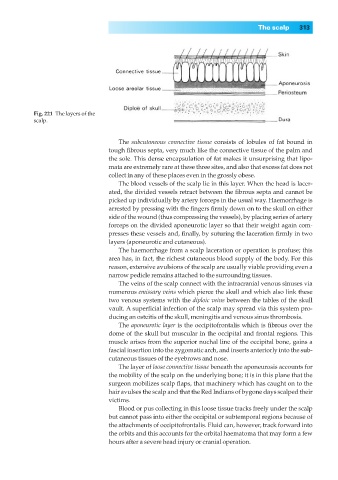
                  Fig. 221◊The layers of the
                  scalp.


                                          The  subcutaneous connective tissue consists of lobules of fat bound in
                                        tough fibrous septa, very much like the connective tissue of the palm and
                                        the sole. This dense encapsulation of fat makes it unsurprising that lipo-
                                        mata are extremely rare at these three sites, and also that excess fat does not
                                        collect in any of these places even in the grossly obese.
                                          The blood vessels of the scalp lie in this layer. When the head is lacer-
                                        ated, the divided vessels retract between the fibrous septa and cannot be
                                        picked up individually by artery forceps in the usual way. Haemorrhage is
                                        arrested by pressing with the fingers firmly down on to the skull on either
                                        side of the wound (thus compressing the vessels), by placing series of artery
                                        forceps on the divided aponeurotic layer so that their weight again com-
                                        presses these vessels and, finally, by suturing the laceration firmly in two
                                        layers (aponeurotic and cutaneous).
                                          The haemorrhage from a scalp laceration or operation is profuse; this
                                        area has, in fact, the richest cutaneous blood supply of the body. For this
                                        reason, extensive avulsions of the scalp are usually viable providing even a
                                        narrow pedicle remains attached to the surrounding tissues.
                                          The veins of the scalp connect with the intracranial venous sinuses via
                                        numerous emissary veins which pierce the skull and which also link these
                                        two venous systems with the diploic veins between the tables of the skull
                                        vault. A superficial infection of the scalp may spread via this system pro-
                                        ducing an osteitis of the skull, meningitis and venous sinus thrombosis.
                                          The aponeurotic layer is the occipitofrontalis which is fibrous over the
                                        dome of the skull but muscular in the occipital and frontal regions. This
                                        muscle arises from the superior nuchal line of the occipital bone, gains a
                                        fascial insertion into the zygomatic arch, and inserts anteriorly into the sub-
                                        cutaneous tissues of the eyebrows and nose.
                                          The layer of loose connective tissue beneath the aponeurosis accounts for
                                        the mobility of the scalp on the underlying bone; it is in this plane that the
                                        surgeon mobilizes scalp flaps, that machinery which has caught on to the
                                        hair avulses the scalp and that the Red Indians of bygone days scalped their
                                        victims.
                                          Blood or pus collecting in this loose tissue tracks freely under the scalp
                                        but cannot pass into either the occipital or subtemporal regions because of
                                        the attachments of occipitofrontalis. Fluid can, however, track forward into
                                        the orbits and this accounts for the orbital haematoma that may form a few
                                        hours after a severe head injury or cranial operation.

