


Page 361 - Clinical Anatomy
P. 361
ECA6  7/18/06  6:54 PM  Page 346


                 346  The central nervous system


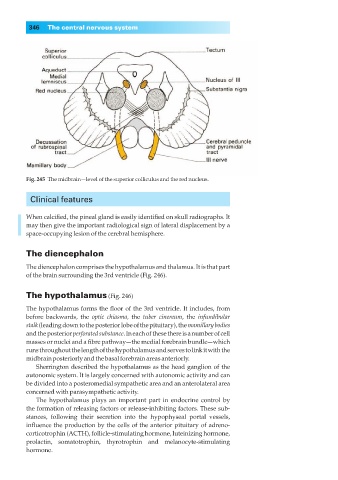
                Fig. 245◊The midbrain—level of the superior colliculus and the red nucleus.


                 Clinical features

                When calcified, the pineal gland is easily identified on skull radiographs. It
                may then give the important radiological sign of lateral displacement by a
                space-occupying lesion of the cerebral hemisphere.


                The diencephalon
                The diencephalon comprises the hypothalamus and thalamus. It is that part
                of the brain surrounding the 3rd ventricle (Fig. 246).

                The hypothalamus (Fig. 246)

                The hypothalamus forms the floor of the 3rd ventricle. It includes, from
                before backwards, the  optic chiasma, the  tuber cinereum, the  infundibular
                stalk(leading down to the posterior lobe of the pituitary), the mamillary bodies
                and the posterior perforated substance. In each of these there is a number of cell
                masses or nuclei and a fibre pathway—the medial forebrain bundle—which
                runs throughout the length of the hypothalamus and serves to link it with the
                midbrain posteriorly and the basal forebrain areas anteriorly.
                   Sherrington described the hypothalamus as the head ganglion of the
                autonomic system. It is largely concerned with autonomic activity and can
                be divided into a posteromedial sympathetic area and an anterolateral area
                concerned with parasympathetic activity.
                   The hypothalamus plays an important part in endocrine control by
                the formation of releasing factors or release-inhibiting factors. These sub-
                stances, following their secretion into the hypophyseal portal vessels,
                influence the production by the cells of the anterior pituitary of adreno-
                corticotrophin (ACTH), follicle-stimulating hormone, luteinizing hormone,
                prolactin, somatotrophin, thyrotrophin and melanocyte-stimulating
                hormone.

