


Page 389 - Clinical Anatomy
P. 389
ECA6  7/18/06  6:54 PM  Page 374


                 374  The central nervous system


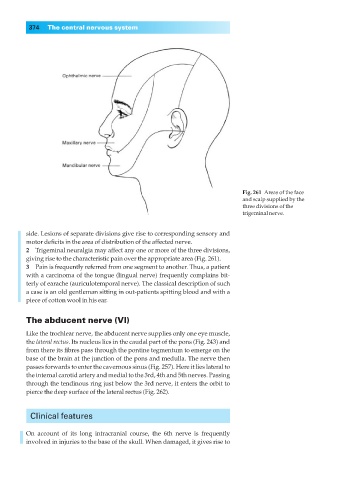
                                                                              Fig. 261◊Areas of the face
                                                                              and scalp supplied by the
                                                                              three divisions of the
                                                                              trigeminal nerve.


                side. Lesions of separate divisions give rise to corresponding sensory and
                motor deficits in the area of distribution of the affected nerve.
                2◊◊Trigeminal neuralgia may affect any one or more of the three divisions,
                giving rise to the characteristic pain over the appropriate area (Fig. 261).
                3◊◊Pain is frequently referred from one segment to another. Thus, a patient
                with a carcinoma of the tongue (lingual nerve) frequently complains bit-
                terly of earache (auriculotemporal nerve). The classical description of such
                a case is an old gentleman sitting in out-patients spitting blood and with a
                piece of cotton wool in his ear.


                The abducent nerve (VI)
                Like the trochlear nerve, the abducent nerve supplies only one eye muscle,
                the lateral rectus. Its nucleus lies in the caudal part of the pons (Fig. 243) and
                from there its fibres pass through the pontine tegmentum to emerge on the
                base of the brain at the junction of the pons and medulla. The nerve then
                passes forwards to enter the cavernous sinus (Fig. 257). Here it lies lateral to
                the internal carotid artery and medial to the 3rd, 4th and 5th nerves. Passing
                through the tendinous ring just below the 3rd nerve, it enters the orbit to
                pierce the deep surface of the lateral rectus (Fig. 262).


                 Clinical features

                On account of its long intracranial course, the 6th nerve is frequently
                involved in injuries to the base of the skull. When damaged, it gives rise to

