


Page 385 - Clinical Anatomy
P. 385
ECA6  7/18/06  6:54 PM  Page 370


                 370  The central nervous system


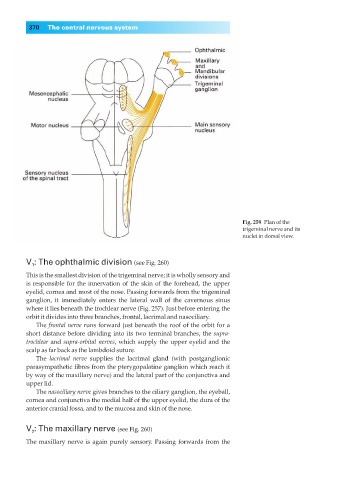
                                                                              Fig. 259◊Plan of the
                                                                              trigeminal nerve and its
                                                                              nuclei in dorsal view.


                V : The ophthalmic division (see Fig. 260)
                 1
                This is the smallest division of the trigeminal nerve; it is wholly sensory and
                is responsible for the innervation of the skin of the forehead, the upper
                eyelid, cornea and most of the nose. Passing forwards from the trigeminal
                ganglion, it immediately enters the lateral wall of the cavernous sinus
                where it lies beneath the trochlear nerve (Fig. 257). Just before entering the
                orbit it divides into three branches, frontal, lacrimal and nasociliary.
                   The frontal nerve runs forward just beneath the roof of the orbit for a
                short distance before dividing into its two terminal branches, the supra-
                trochlear and supra-orbital nerves, which supply the upper eyelid and the
                scalp as far back as the lambdoid suture.
                   The  lacrimal nerve supplies the lacrimal gland (with postganglionic
                parasympathetic fibres from the pterygopalatine ganglion which reach it
                by way of the maxillary nerve) and the lateral part of the conjunctiva and
                upper lid.
                   The nasociliary nerve gives branches to the ciliary ganglion, the eyeball,
                cornea and conjunctiva the medial half of the upper eyelid, the dura of the
                anterior cranial fossa, and to the mucosa and skin of the nose.

                V : The maxillary nerve (see Fig. 260)
                 2
                The maxillary nerve is again purely sensory. Passing forwards from the

