


Page 384 - Clinical Anatomy
P. 384
ECA6  7/18/06  6:54 PM  Page 369


                                                                          The cranial nerves   369


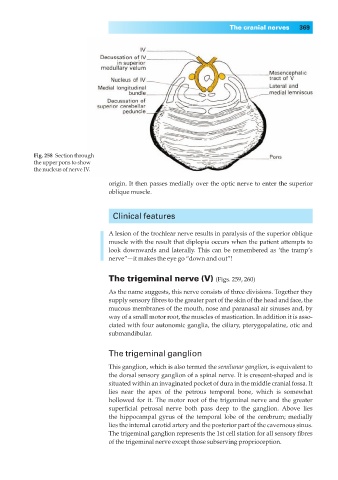
                  Fig. 258◊Section through
                  the upper pons to show
                  the nucleus of nerve IV.

                                        origin. It then passes medially over the optic nerve to enter the superior
                                        oblique muscle.


                                         Clinical features

                                        A lesion of the trochlear nerve results in paralysis of the superior oblique
                                        muscle with the result that diplopia occurs when the patient attempts to
                                        look downwards and laterally. This can be remembered as ‘the tramp’s
                                        nerve”—it makes the eye go “down and out”!


                                        The trigeminal nerve (V) (Figs. 259, 260)
                                        As the name suggests, this nerve consists of three divisions. Together they
                                        supply sensory fibres to the greater part of the skin of the head and face, the
                                        mucous membranes of the mouth, nose and paranasal air sinuses and, by
                                        way of a small motor root, the muscles of mastication. In addition it is asso-
                                        ciated with four autonomic ganglia, the ciliary, pterygopalatine, otic and
                                        submandibular.


                                        The trigeminal ganglion
                                        This ganglion, which is also termed the semilunar ganglion, is equivalent to
                                        the dorsal sensory ganglion of a spinal nerve. It is crescent-shaped and is
                                        situated within an invaginated pocket of dura in the middle cranial fossa. It
                                        lies near the apex of the petrous temporal bone, which is somewhat
                                        hollowed for it. The motor root of the trigeminal nerve and the greater
                                        superficial petrosal nerve both pass deep to the ganglion.  Above lies
                                        the hippocampal gyrus of the temporal lobe of the cerebrum; medially
                                        lies the internal carotid artery and the posterior part of the cavernous sinus.
                                        The trigeminal ganglion represents the 1st cell station for all sensory fibres
                                        of the trigeminal nerve except those subserving proprioception.

