


Page 398 - Clinical Anatomy
P. 398
ECA6  7/18/06  6:54 PM  Page 383


                                                                          The special senses   383


                                        The special senses


                                        The nose (see also ‘The accessory nasal sinuses’, page 318)
                                        The external nose consists of a bony and cartilaginous framework closely
                                        overlaid by skin and fibrofatty tissues. The bones are the two nasal bones
                                        and the frontal processes of the maxilla. The ala is composed solely of fatty
                                        tissue at its lower free edge.
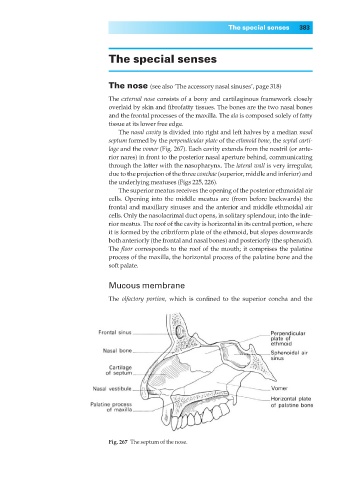
                                          The nasal cavity is divided into right and left halves by a median nasal
                                        septum formed by the perpendicular plate of the ethmoid bone, the septal carti-
                                        lage and the vomer (Fig. 267). Each cavity extends from the nostril (or ante-
                                        rior nares) in front to the posterior nasal aperture behind, communicating
                                        through the latter with the nasopharynx. The lateral wall is very irregular,
                                        due to the projection of the three conchae (superior, middle and inferior) and
                                        the underlying meatuses (Figs 225, 226).
                                          The superior meatus receives the opening of the posterior ethmoidal air
                                        cells. Opening into the middle meatus are (from before backwards) the
                                        frontal and maxillary sinuses and the anterior and middle ethmoidal air
                                        cells. Only the nasolacrimal duct opens, in solitary splendour, into the infe-
                                        rior meatus. The roof of the cavity is horizontal in its central portion, where
                                        it is formed by the cribriform plate of the ethmoid, but slopes downwards
                                        both anteriorly (the frontal and nasal bones) and posteriorly (the sphenoid).
                                        The floor corresponds to the roof of the mouth; it comprises the palatine
                                        process of the maxilla, the horizontal process of the palatine bone and the
                                        soft palate.

                                        Mucous membrane

                                        The  olfactory portion, which is confined to the superior concha and the


                                        Fig. 267◊The septum of the nose.

