


Page 402 - Clinical Anatomy
P. 402
ECA6  7/18/06  6:54 PM  Page 387


                                                                          The special senses   387


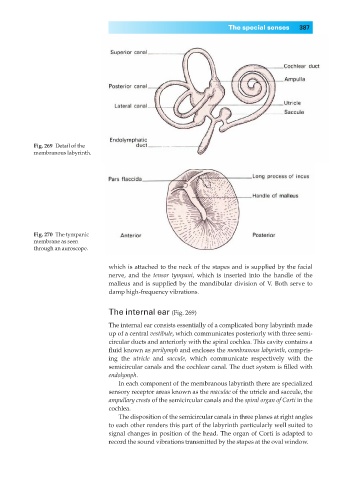
                  Fig. 269◊Detail of the
                  membranous labyrinth.


                  Fig. 270◊The tympanic
                  membrane as seen
                  through an auroscope.

                                        which is attached to the neck of the stapes and is supplied by the facial
                                        nerve, and the  tensor tympani, which is inserted into the handle of the
                                        malleus and is supplied by the mandibular division of V. Both serve to
                                        damp high-frequency vibrations.


                                        The internal ear (Fig. 269)
                                        The internal ear consists essentially of a complicated bony labyrinth made
                                        up of a central vestibule, which communicates posteriorly with three semi-
                                        circular ducts and anteriorly with the spiral cochlea. This cavity contains a
                                        fluid known as perilymph and encloses the membranous labyrinth, compris-
                                        ing the  utricle and  saccule, which communicate respectively with the
                                        semicircular canals and the cochlear canal. The duct system is filled with
                                        endolymph.
                                          In each component of the membranous labyrinth there are specialized
                                        sensory receptor areas known as the maculae of the utricle and saccule, the
                                        ampullary crests of the semicircular canals and the spiral organ of Corti in the
                                        cochlea.
                                          The disposition of the semicircular canals in three planes at right angles
                                        to each other renders this part of the labyrinth particularly well suited to
                                        signal changes in position of the head. The organ of Corti is adapted to
                                        record the sound vibrations transmitted by the stapes at the oval window.

