


Page 400 - Clinical Anatomy
P. 400
ECA6  7/18/06  6:54 PM  Page 385


                                                                          The special senses   385


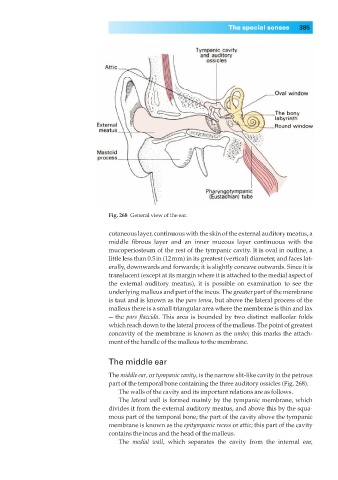
                                        Fig. 268◊General view of the ear.

                                        cutaneous layer, continuous with the skin of the external auditory meatus, a
                                        middle fibrous layer and an inner mucous layer continuous with the
                                        mucoperiosteum of the rest of the tympanic cavity. It is oval in outline, a
                                        little less than 0.5in (12mm) in its greatest (vertical) diameter, and faces lat-
                                        erally, downwards and forwards; it is slightly concave outwards. Since it is
                                        translucent (except at its margin where it is attached to the medial aspect of
                                        the external auditory meatus), it is possible on examination to see the
                                        underlying malleus and part of the incus. The greater part of the membrane
                                        is taut and is known as the pars tensa, but above the lateral process of the
                                        malleus there is a small triangular area where the membrane is thin and lax
                                        — the pars flaccida. This area is bounded by two distinct malleolar folds
                                        which reach down to the lateral process of the malleus. The point of greatest
                                        concavity of the membrane is known as the umbo; this marks the attach-
                                        ment of the handle of the malleus to the membrane.

                                        The middle ear

                                        The middle ear, or tympanic cavity, is the narrow slit-like cavity in the petrous
                                        part of the temporal bone containing the three auditory ossicles (Fig. 268).
                                          The walls of the cavity and its important relations are as follows.
                                          The lateral wall is formed mainly by the tympanic membrane, which
                                        divides it from the external auditory meatus, and above this by the squa-
                                        mous part of the temporal bone; the part of the cavity above the tympanic
                                        membrane is known as the epitympanic recess or attic; this part of the cavity
                                        contains the incus and the head of the malleus.
                                          The  medial wall, which separates the cavity from the internal ear,

