


Page 53 - Clinical Anatomy
P. 53
ECA1  7/18/06  6:31 PM  Page 38


                 38  The Thorax


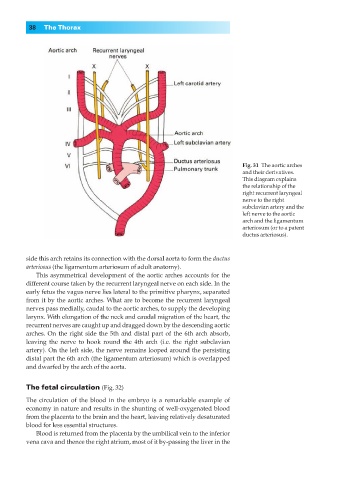
                                                                              Fig. 31◊The aortic arches
                                                                              and their derivatives.
                                                                              This diagram explains
                                                                              the relationship of the
                                                                              right recurrent laryngeal
                                                                              nerve to the right
                                                                              subclavian artery and the
                                                                              left nerve to the aortic
                                                                              arch and the ligamentum
                                                                              arteriosum (or to a patent
                                                                              ductus arteriosus).


                side this arch retains its connection with the dorsal aorta to form the ductus
                arteriosus (the ligamentum arteriosum of adult anatomy).
                   This asymmetrical development of the aortic arches accounts for the
                different course taken by the recurrent laryngeal nerve on each side. In the
                early fetus the vagus nerve lies lateral to the primitive pharynx, separated
                from it by the aortic arches. What are to become the recurrent laryngeal
                nerves pass medially, caudal to the aortic arches, to supply the developing
                larynx. With elongation of the neck and caudal migration of the heart, the
                recurrent nerves are caught up and dragged down by the descending aortic
                arches. On the right side the 5th and distal part of the 6th arch absorb,
                leaving the nerve to hook round the 4th arch (i.e. the right subclavian
                artery). On the left side, the nerve remains looped around the persisting
                distal part the 6th arch (the ligamentum arteriosum) which is overlapped
                and dwarfed by the arch of the aorta.


                The fetal circulation (Fig. 32)
                The circulation of the blood in the embryo is a remarkable example of
                economy in nature and results in the shunting of well-oxygenated blood
                from the placenta to the brain and the heart, leaving relatively desaturated
                blood for less essential structures.
                   Blood is returned from the placenta by the umbilical vein to the inferior
                vena cava and thence the right atrium, most of it by-passing the liver in the

