


Page 100 - Clinical Application of Mechanical Ventilation
P. 100
66     Chapter 3


                      TERMINOLOGY OF VENTILATION MODES


                                            A mechanical ventilation mode is defined as “a specific combination of breathing
                                            pattern, control type, and operational algorithms” (Chatburn, 2007). With the ad-
                                            vent of microprocessor-controlled ventilators, the variety and complexity of modes
                                            has dramatically increased (Branson et al., 2004). It is important to understand
                                            mechanical ventilation modes in order to match breath delivery to specific clinical
                                            application and patient needs. This section provides the terminology of basic ven-
                                            tilation modes. Chapter 4 will discuss the clinical application of commonly used
                                            modes of ventilation along with the respective waveforms.

                                            Volume-Controlled Ventilation


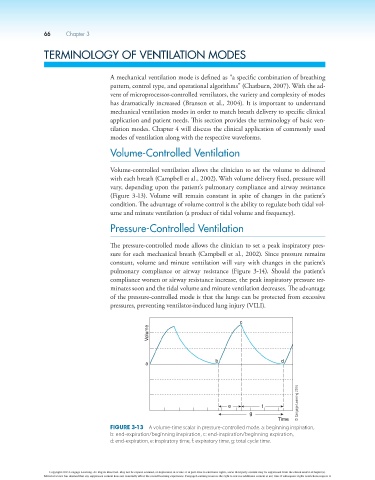
                                            Volume-controlled ventilation allows the clinician to set the volume to delivered
                                            with each breath (Campbell et al., 2002). With volume delivery fixed, pressure will
                                            vary, depending upon the patient’s pulmonary compliance and airway resistance
                                            (Figure 3-13). Volume will remain constant in spite of changes in the patient’s
                                            condition. The advantage of volume control is the ability to regulate both tidal vol-
                                            ume and minute ventilation (a product of tidal volume and frequency).
                                            Pressure-Controlled Ventilation


                                            The pressure-controlled mode allows the clinician to set a peak inspiratory pres-
                                            sure for each mechanical breath (Campbell et al., 2002). Since pressure remains
                                            constant, volume and minute ventilation will vary with changes in the patient’s
                                            pulmonary  compliance  or  airway  resistance  (Figure  3-14).  Should  the  patient’s
                                            compliance worsen or airway resistance increase, the peak inspiratory pressure ter-
                                            minates soon and the tidal volume and minute ventilation decreases. The advantage
                                            of the pressure-controlled mode is that the lungs can be protected from excessive
                                            pressures, preventing ventilator-induced lung injury (VILI).

                                                                                      c
                                                        Volume


                                                                              b                    d
                                                       a


                                                                                                         © Cengage Learning 2014

                                                                                  e          f
                                                                                         g
                                                                                                  Time
                                            Figure 3-13  A volume-time scalar in pressure-controlled mode. a: beginning inspiration,
                                            b: end-expiration/beginning inspiration, c: end-inspiration/beginning expiration,
                                            d: end-expiration, e: inspiratory time, f: expiratory time, g: total cycle time.


                        Copyright 2013 Cengage Learning. All Rights Reserved. May not be copied, scanned, or duplicated, in whole or in part. Due to electronic rights, some third party content may be suppressed from the eBook and/or eChapter(s).
                      Editorial review has deemed that any suppressed content does not materially affect the overall learning experience. Cengage Learning reserves the right to remove additional content at any time if subsequent rights restrictions require it.

