


Page 125 - Clinical Application of Mechanical Ventilation
P. 125
Operating Modes of Mechanical Ventilation  91


                                                     60

                                                     50
                                                    Airway Pressure (cm H 2 O)  40

                                                     30
                                                     20
                                                     10
                                                      0

                                                    –10

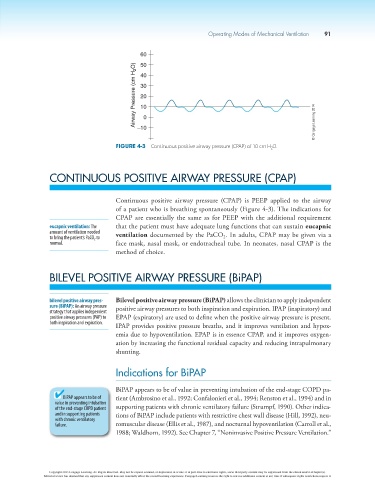
                                             Figure 4-3  Continuous positive airway pressure (CPAP) of 10 cm H 2 O.  © Cengage Learning 2014


                        CONTINUOUS POSITIVE AIRWAY PRESSURE (CPAP)


                                             Continuous  positive  airway  pressure  (CPAP)  is  PEEP  applied  to  the  airway
                                             of a patient who is breathing spontaneously (Figure 4-3). The indications for
                                             CPAP are essentially the same as for PEEP with the additional requirement
                        eucapnic ventilation: The   that the patient must have adequate lung functions that can sustain eucapnic
                        amount of ventilation needed   ventilation documented by the PaCO . In adults, CPAP may be given via a
                        to bring the patient’s PaCO 2  to                       2
                        normal.              face mask, nasal mask, or endotracheal tube. In neonates, nasal CPAP is the
                                             method of choice.


                        BILEVEL POSITIVE AIRWAY PRESSURE (BiPAP)


                        bilevel positive airway pres-  Bilevel positive airway pressure (BiPAP) allows the clinician to apply independent
                        sure (BiPAP): An airway pressure   positive airway pressures to both inspiration and expiration. IPAP (inspiratory) and
                        strategy that applies independent
                        positive airway pressures (PAP) to   EPAP (expiratory) are used to define when the positive airway pressure is present.
                        both inspiration and expiration.
                                             IPAP provides positive pressure breaths, and it improves ventilation and hypox-
                                             emia due to hypoventilation. EPAP is in essence CPAP, and it improves oxygen-
                                             ation by increasing the functional residual capacity and reducing intrapulmonary
                                             shunting.


                                             Indications for BiPAP


                                             BiPAP appears to be of value in preventing intubation of the end-stage COPD pa-
                            BiPAP appears to be of   tient (Ambrosino et al., 1992; Confalonieri et al., 1994; Renston et al., 1994) and in
                          value in preventing intubation
                          of the end-stage COPD patient   supporting patients with chronic ventilatory failure (Strumpf, 1990). Other indica-
                          and in supporting patients   tions of BiPAP include patients with restrictive chest wall disease (Hill, 1992), neu-
                          with chronic ventilatory
                          failure.           romuscular disease (Ellis et al., 1987), and nocturnal hypoventilation (Carroll et al.,
                                             1988; Waldhorn, 1992). See Chapter 7, “Noninvasive Positive Pressure Ventilation.”


                        Copyright 2013 Cengage Learning. All Rights Reserved. May not be copied, scanned, or duplicated, in whole or in part. Due to electronic rights, some third party content may be suppressed from the eBook and/or eChapter(s).
                      Editorial review has deemed that any suppressed content does not materially affect the overall learning experience. Cengage Learning reserves the right to remove additional content at any time if subsequent rights restrictions require it.

