


Page 138 - Clinical Application of Mechanical Ventilation
P. 138
104    Chapter 4


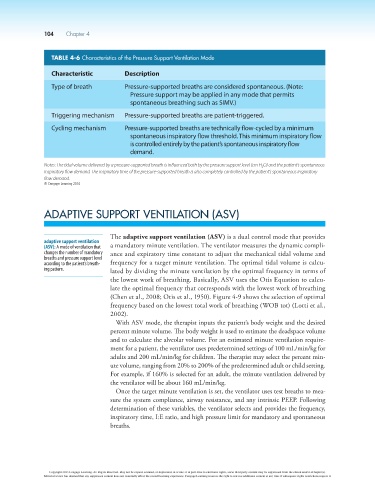
                        TABLE 4-6 Characteristics of the Pressure Support Ventilation Mode

                        Characteristic          Description

                        Type of breath          Pressure-supported breaths are considered spontaneous. (Note:
                                                  Pressure support may be applied in any mode that permits
                                                  spontaneous breathing such as SIMV.)

                        Triggering mechanism    Pressure-supported breaths are patient-triggered.

                        Cycling mechanism       Pressure-supported breaths are technically flow-cycled by a minimum
                                                  spontaneous inspiratory flow threshold. This minimum inspiratory flow
                                                  is controlled entirely by the patient’s spontaneous inspiratory flow
                                                  demand.

                      Notes: The tidal volume delivered by a pressure-supported breath is influenced both by the pressure support level (cm H 2 O) and the patient’s spontaneous
                      inspiratory flow demand. The inspiratory time of the pressure-supported breath is also completely controlled by the patient’s spontaneous inspiratory
                      flow demand.
                      © Cengage Learning 2014


                      ADAPTIVE SUPPORT VENTILATION (ASV)


                                            The adaptive support ventilation (ASV) is a dual control mode that provides
                      adaptive support ventilation
                      (ASV): A mode of ventilation that   a mandatory minute ventilation. The ventilator measures the dynamic compli-
                      changes the number of mandatory   ance and expiratory time constant to adjust the mechanical tidal volume and
                      breaths and pressure support level
                      according to the patient’s breath-  frequency for a target minute ventilation. The optimal tidal volume is calcu-
                      ing pattern.          lated by dividing the minute ventilation by the optimal frequency in terms of
                                            the lowest work of breathing. Basically, ASV uses the Otis Equation to calcu-
                                            late the optimal frequency that corresponds with the lowest work of breathing
                                            (Chen et al., 2008; Otis et al., 1950). Figure 4-9 shows the selection of optimal
                                            frequency based on the lowest total work of breathing (WOB tot) (Lotti et al.,
                                            2002).
                                             With ASV mode, the therapist inputs the patient’s body weight and the desired
                                            percent minute volume. The body weight is used to estimate the deadspace volume
                                            and to calculate the alveolar volume. For an estimated minute ventilation require-
                                            ment for a patient, the ventilator uses predetermined settings of 100 mL/min/kg for
                                            adults and 200 mL/min/kg for children. The therapist may select the percent min-
                                            ute volume, ranging from 20% to 200% of the predetermined adult or child setting.
                                            For example, if 160% is selected for an adult, the minute ventilation delivered by
                                            the ventilator will be about 160 mL/min/kg.
                                             Once the target minute ventilation is set, the ventilator uses test breaths to mea-
                                            sure the system compliance, airway resistance, and any intrinsic PEEP. Following
                                            determination of these variables, the ventilator selects and provides the frequency,
                                            inspiratory time, I:E ratio, and high pressure limit for mandatory and spontaneous
                                            breaths.


                        Copyright 2013 Cengage Learning. All Rights Reserved. May not be copied, scanned, or duplicated, in whole or in part. Due to electronic rights, some third party content may be suppressed from the eBook and/or eChapter(s).
                      Editorial review has deemed that any suppressed content does not materially affect the overall learning experience. Cengage Learning reserves the right to remove additional content at any time if subsequent rights restrictions require it.

