


Page 134 - Clinical Application of Mechanical Ventilation
P. 134
100    Chapter 4


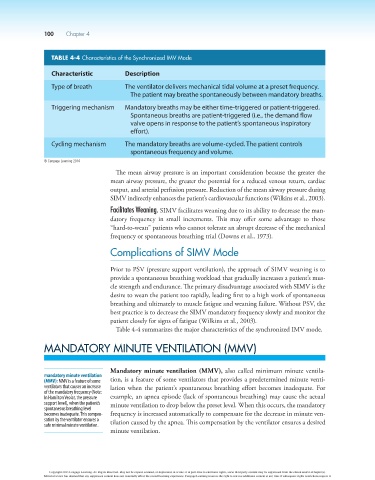
                        TABLE 4-4 Characteristics of the Synchronized IMV Mode

                        Characteristic          Description

                        Type of breath          The ventilator delivers mechanical tidal volume at a preset frequency.
                                                  The patient may breathe spontaneously between mandatory breaths.
                        Triggering mechanism    Mandatory breaths may be either time-triggered or patient-triggered.
                                                  Spontaneous breaths are patient-triggered (i.e., the demand flow
                                                  valve opens in response to the patient’s spontaneous inspiratory
                                                  effort).

                        Cycling mechanism       The mandatory breaths are volume-cycled. The patient controls
                                                  spontaneous frequency and volume.
                      © Cengage Learning 2014
                                             The mean airway pressure is an important consideration because the greater the
                                            mean airway pressure, the greater the potential for a reduced venous return, cardiac
                                            output, and arterial perfusion pressure. Reduction of the mean airway pressure during
                                            SIMV indirectly enhances the patient’s cardiovascular functions (Wilkins et al., 2003).
                                            Facilitates Weaning. SIMV facilitates weaning due to its ability to decrease the man-
                                            datory  frequency  in  small  increments.  This  may  offer  some  advantage  to  those
                                            “hard-to-wean” patients who cannot tolerate an abrupt decrease of the mechanical
                                            frequency or spontaneous breathing trial (Downs et al., 1973).

                                            Complications of SIMV Mode


                                            Prior to PSV (pressure support ventilation), the approach of SIMV weaning is to
                                            provide a spontaneous breathing workload that gradually increases a patient’s mus-
                                            cle strength and endurance. The primary disadvantage associated with SIMV is the
                                            desire to wean the patient too rapidly, leading first to a high work of spontaneous
                                            breathing and ultimately to muscle fatigue and weaning failure. Without PSV, the
                                            best practice is to decrease the SIMV mandatory frequency slowly and monitor the
                                            patient closely for signs of fatigue (Wilkins et al., 2003).
                                             Table 4-4 summarizes the major characteristics of the synchronized IMV mode.


                      MANDATORY MINUTE VENTILATION (MMV)


                                            Mandatory minute ventilation (MMV), also called minimum minute ventila-
                      mandatory minute ventilation
                      (MMV): MMV is a feature of some   tion, is a feature of some ventilators that provides a predetermined minute venti-
                      ventilators that causes an increase   lation when the patient’s spontaneous breathing effort becomes inadequate. For
                      of the mandatory frequency (Note:
                      In Hamilton Veolar, the pressure   example, an apnea episode (lack of spontaneous breathing) may cause the actual
                      support level), when the patient’s   minute ventilation to drop below the preset level. When this occurs, the mandatory
                      spontaneous breathing level
                      becomes inadequate. This compen-  frequency is increased automatically to compensate for the decrease in minute ven-
                      sation by the ventilator ensures a   tilation caused by the apnea. This compensation by the ventilator ensures a desired
                      safe minimal minute ventilation.
                                            minute ventilation.


                        Copyright 2013 Cengage Learning. All Rights Reserved. May not be copied, scanned, or duplicated, in whole or in part. Due to electronic rights, some third party content may be suppressed from the eBook and/or eChapter(s).
                      Editorial review has deemed that any suppressed content does not materially affect the overall learning experience. Cengage Learning reserves the right to remove additional content at any time if subsequent rights restrictions require it.

