


Page 140 - Clinical Application of Mechanical Ventilation
P. 140
106    Chapter 4


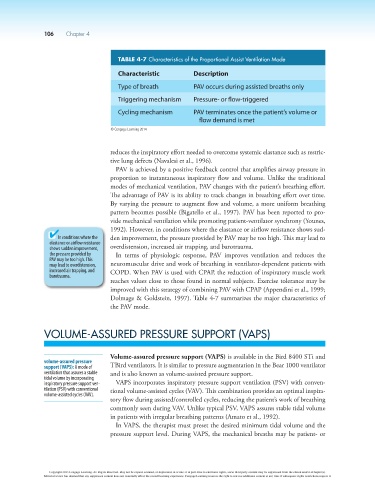
                                              TABLE 4-7 Characteristics of the Proportional Assist Ventilation Mode
                                              Characteristic           Description

                                              Type of breath           PAV occurs during assisted breaths only

                                              Triggering mechanism     Pressure- or flow-triggered
                                              Cycling mechanism        PAV terminates once the patient’s volume or
                                                                         flow demand is met
                                            © Cengage Learning 2014


                                            reduces the inspiratory effort needed to overcome systemic elastance such as restric-
                                            tive lung defects (Navalesi et al., 1996).
                                             PAV is achieved by a positive feedback control that amplifies airway pressure in
                                            proportion to instantaneous inspiratory flow and volume. Unlike the traditional
                                            modes of mechanical ventilation, PAV changes with the patient’s breathing effort.
                                            The advantage of PAV is its ability to track changes in breathing effort over time.
                                            By varying the pressure to augment flow and volume, a more uniform breathing
                                            pattern becomes possible (Bigatello et al., 1997). PAV has been reported to pro-
                                            vide mechanical ventilation while promoting patient-ventilator synchrony (Younes,
                                            1992). However, in conditions where the elastance or airflow resistance shows sud-
                          In conditions where the   den improvement, the pressure provided by PAV may be too high. This may lead to
                        elastance or airflow resistance
                        shows sudden improvement,   overdistension, increased air trapping, and barotrauma.
                        the pressure provided by   In  terms  of  physiologic  response,  PAV  improves  ventilation  and  reduces  the
                        PAV may be too high. This
                        may lead to overdistension,   neuromuscular drive and work of breathing in ventilator-dependent patients with
                        increased air trapping, and   COPD. When PAV is used with CPAP, the reduction of inspiratory muscle work
                        barotrauma.
                                            reaches values close to those found in normal subjects. Exercise tolerance may be
                                            improved with this strategy of combining PAV with CPAP (Appendini et al., 1999;
                                            Dolmage & Goldstein, 1997). Table 4-7 summarizes the major characteristics of
                                            the PAV mode.


                      VOLUME-ASSURED PRESSURE SUPPORT (VAPS)


                                            Volume-assured pressure support (VAPS) is available in the Bird 8400 STi and
                      volume-assured pressure
                      support (VAPS): A mode of   TBird ventilators. It is similar to pressure augmentation in the Bear 1000 ventilator
                      ventilation that assures a stable   and is also known as volume-assisted pressure support.
                      tidal volume by incorporating
                      inspiratory pressure support ven-  VAPS incorporates inspiratory pressure support ventilation (PSV) with conven-
                      tilation (PSV) with conventional   tional volume-assisted cycles (VAV). This combination provides an optimal inspira-
                      volume-assisted cycles (VAV).
                                            tory flow during assisted/controlled cycles, reducing the patient’s work of breathing
                                            commonly seen during VAV. Unlike typical PSV, VAPS assures stable tidal volume
                                            in patients with irregular breathing patterns (Amato et al., 1992).
                                             In VAPS, the therapist must preset the desired minimum tidal volume and the
                                            pressure support level. During VAPS, the mechanical breaths may be patient- or


                        Copyright 2013 Cengage Learning. All Rights Reserved. May not be copied, scanned, or duplicated, in whole or in part. Due to electronic rights, some third party content may be suppressed from the eBook and/or eChapter(s).
                      Editorial review has deemed that any suppressed content does not materially affect the overall learning experience. Cengage Learning reserves the right to remove additional content at any time if subsequent rights restrictions require it.

