


Page 139 - Clinical Application of Mechanical Ventilation
P. 139
Operating Modes of Mechanical Ventilation  105


                                                  0.18
                                                  0.16                                               WOB,res (J/s)
                                                                                                     WOB,el (J/s)
                                                  0.14
                                                                                                     WOB,tot (J/s)
                                                  0.12                                               Best Rate Point

                                                              14
                                                  0.10
                                                WOB (J/s)  0.08


                                                  0.06

                                                  0.04

                                                  0.02

                                                  0.00                                                            © Cengage Learning 2014
                                                     0     10     20    30     40    50
                                                                Frequency (b/min)
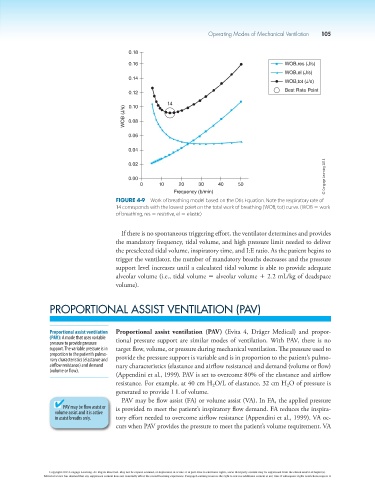
                                             Figure 4-9  Work of breathing model based on the Otis Equation. Note the respiratory rate of
                                             14 corresponds with the lowest point on the total work of breathing (WOB, tot) curve. (WOB 5 work
                                             of breathing, res 5 resistive, el 5 elastic)


                                               If there is no spontaneous triggering effort, the ventilator determines and provides
                                             the mandatory frequency, tidal volume, and high pressure limit needed to deliver
                                             the preselected tidal volume, inspiratory time, and I:E ratio. As the patient begins to
                                             trigger the ventilator, the number of mandatory breaths decreases and the pressure
                                             support level increases until a calculated tidal volume is able to provide adequate
                                             alveolar volume (i.e., tidal volume 5 alveolar volume 1 2.2 mL/kg of deadspace
                                             volume).


                        PROPORTIONAL ASSIST VENTILATION (PAV)


                        Proportional assist ventilation   Proportional  assist  ventilation  (PAV)  (Evita  4,  Dräger  Medical)  and  propor-
                        (PAV): A mode that uses variable   tional pressure support are similar modes of ventilation. With PAV, there is no
                        pressure to provide pressure
                        support. The variable pressure is in   target flow, volume, or pressure during mechanical ventilation. The pressure used to
                        proportion to the patient’s pulmo-
                        nary characteristics (elastance and   provide the pressure support is variable and is in proportion to the patient’s pulmo-
                        airflow resistance) and demand   nary characteristics (elastance and airflow resistance) and demand (volume or flow)
                        (volume or flow).
                                             (Appendini et al., 1999). PAV is set to overcome 80% of the elastance and airflow
                                             resistance. For example, at 40 cm H O/L of elastance, 32 cm H O of pressure is
                                                                             2
                                                                                                     2
                                             generated to provide 1 L of volume.
                                               PAV may be flow assist (FA) or volume assist (VA). In FA, the applied pressure
                            PAV may be flow assist or   is provided to meet the patient’s inspiratory flow demand. FA reduces the inspira-
                          volume assist and it is active
                          in assist breaths only.  tory effort needed to overcome airflow resistance (Appendini et al., 1999). VA oc-
                                             curs when PAV provides the pressure to meet the patient’s volume requirement. VA


                        Copyright 2013 Cengage Learning. All Rights Reserved. May not be copied, scanned, or duplicated, in whole or in part. Due to electronic rights, some third party content may be suppressed from the eBook and/or eChapter(s).
                      Editorial review has deemed that any suppressed content does not materially affect the overall learning experience. Cengage Learning reserves the right to remove additional content at any time if subsequent rights restrictions require it.

