


Page 214 - Clinical Application of Mechanical Ventilation
P. 214
180    Chapter 6


                        TABLE 6-10 General Criteria for Extubation

                        Criteria                             Methods of Assessment

                        Rapid shallow breathing index        f/V  less than 100/min/L
                                                                T
                        Blood gases                          Acceptable blood gases on F O  less than 40% and
                                                                                         2
                                                                                       I
                                                               spontaneous minute ventilation less than 10 L/min
                                                             PaO /F O  (P/F ratio) . 250 mm Hg
                                                                     2
                                                                   I
                                                                 2
                        Ventilatory reserve                  Maximal inspiratory pressure . 220 cm H O
                                                                                                   2
                                                             Vital capacity . 15 mL/kg
                        Cardiopulmonary assessment           Absence of cardiopulmonary problems (e.g., CHF,
                                                               pulmonary edema, pneumonia, tachycardia,
                                                               arrhythmia, chest retractions, distended stomach)

                      (Data from Epstein, 1995; Listello et al., 1994; Whelan et al., 1994; White, 2002; Whitten, 1997.)
                      © Cengage Learning 2014

                                             If the patient has an adequate vital capacity and cough reflex, the cuff is deflated
                                            completely and the ET tube is removed. Encourage the patient to breathe deeply
                                            and cough, and use a Yankaur (rigid tonsil tip) suction device to remove excess secre-
                                            tions in the patient’s oropharynx.
                                             If the patient does not have an adequate vital capacity and cough reflex, the suc-
                                            tion catheter may be left extending from the distal end of the ET tube and continu-
                                            ous suction is applied while the ET tube is being removed. An alternate method is
                                            to leave the suction catheter in the oropharynx with continuous suction while the
                                            ET tube is being removed. Either method may be used to remove secretions from
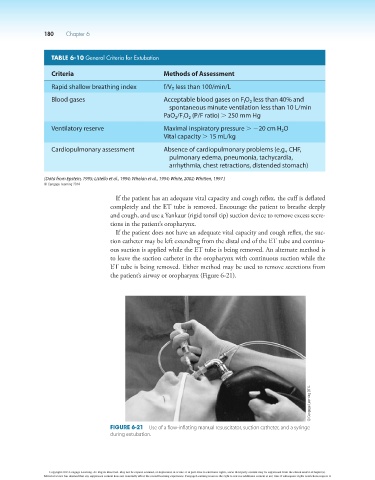
                                            the patient’s airway or oropharynx (Figure 6-21).


                                                                                                             © Cengage Learning 2014


                                            Figure 6-21  Use of a flow-inflating manual resuscitator, suction catheter, and a syringe
                                            during extubation.


                        Copyright 2013 Cengage Learning. All Rights Reserved. May not be copied, scanned, or duplicated, in whole or in part. Due to electronic rights, some third party content may be suppressed from the eBook and/or eChapter(s).
                      Editorial review has deemed that any suppressed content does not materially affect the overall learning experience. Cengage Learning reserves the right to remove additional content at any time if subsequent rights restrictions require it.

