


Page 211 - Clinical Application of Mechanical Ventilation
P. 211
Airway Management in Mechanical Ventilation  177


                        SPEAKING VALVES


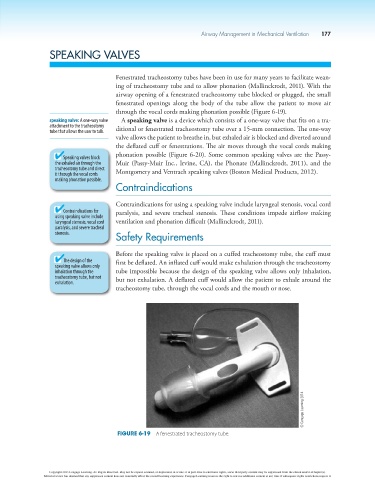
                                             Fenestrated tracheostomy tubes have been in use for many years to facilitate wean-
                                             ing of tracheostomy tube and to allow phonation (Mallinckrodt, 2011). With the
                                             airway opening of a fenestrated tracheostomy tube blocked or plugged, the small
                                             fenestrated  openings  along  the  body  of  the  tube  allow  the  patient  to  move  air
                                             through the vocal cords making phonation possible (Figure 6-19).
                        speaking valve: A one-way valve   A speaking valve is a device which consists of a one-way valve that fits on a tra-
                        attachment to the tracheostomy   ditional or fenestrated tracheostomy tube over a 15-mm connection. The one-way
                        tube that allows the user to talk.
                                             valve allows the patient to breathe in, but exhaled air is blocked and diverted around
                                             the deflated cuff or fenestrations. The air moves through the vocal cords making
                                             phonation possible (Figure 6-20). Some common speaking valves are the Passy-
                            Speaking valves block
                          the exhaled air through the   Muir (Passy-Muir Inc., Irvine, CA), the Phonate (Mallinckrodt, 2011), and the
                          tracheostomy tube and direct   Montgomery and Ventrach speaking valves (Boston Medical Products, 2012).
                          it through the vocal cords
                          making phonation possible.
                                             Contraindications


                                             Contraindications for using a speaking valve include laryngeal stenosis, vocal cord
                            Contraindications for   paralysis,  and  severe  tracheal  stenosis.  These  conditions  impede  airflow  making
                          using speaking valve include
                          laryngeal stenosis, vocal cord   ventilation and phonation difficult (Mallinckrodt, 2011).
                          paralysis, and severe tracheal
                          stenosis.
                                             Safety Requirements

                                             Before the speaking valve is placed on a cuffed tracheostomy tube, the cuff must
                            The design of the   first be deflated. An inflated cuff would make exhalation through the tracheostomy
                          speaking valve allows only
                          inhalation through the   tube impossible because the design of the speaking valve allows only inhalation,
                          tracheostomy tube, but not   but not exhalation. A deflated cuff would allow the patient to exhale around the
                          exhalation.
                                             tracheostomy tube, through the vocal cords and the mouth or nose.


                                                                                                           © Cengage Learning 2014


                                              Figure 6-19  A fenestrated tracheostomy tube.


                        Copyright 2013 Cengage Learning. All Rights Reserved. May not be copied, scanned, or duplicated, in whole or in part. Due to electronic rights, some third party content may be suppressed from the eBook and/or eChapter(s).
                      Editorial review has deemed that any suppressed content does not materially affect the overall learning experience. Cengage Learning reserves the right to remove additional content at any time if subsequent rights restrictions require it.

