


Page 257 - Clinical Application of Mechanical Ventilation
P. 257
Initiation of Mechanical Ventilation  223


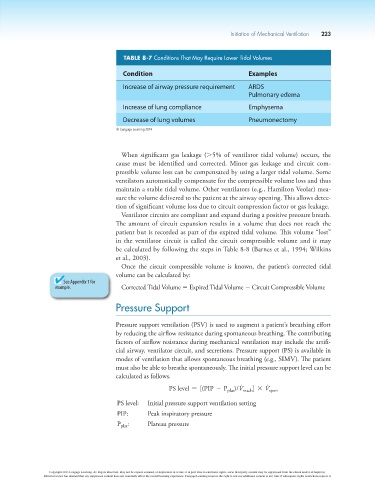
                                                TABLE 8-7 Conditions That May Require Lower Tidal Volumes

                                                Condition                                Examples

                                                Increase	of	airway	pressure	requirement  ARDS
                                                                                         Pulmonary	edema
                                                Increase	of	lung	compliance              Emphysema

                                                Decrease	of	lung	volumes                 Pneumonectomy
                                              © Cengage Learning 2014


                                               When significant gas leakage (.5% of ventilator tidal volume) occurs, the
                                             cause  must  be  identified  and  corrected.  Minor  gas  leakage  and  circuit  com-
                                             pressible volume loss can be compensated by using a larger tidal volume. Some
                                             ventilators automatically compensate for the compressible volume loss and thus
                                             maintain a stable tidal volume. Other ventilators (e.g., Hamilton Veolar) mea-
                                             sure the volume delivered to the patient at the airway opening. This allows detec-
                                             tion of significant volume loss due to circuit compression factor or gas leakage.
                                               Ventilator circuits are compliant and expand during a positive pressure breath.
                                             The amount of circuit expansion results in a volume that does not reach the
                                             patient but is recorded as part of the expired tidal volume. This volume “lost”
                                             in  the  ventilator  circuit  is  called  the  circuit  compressible  volume  and  it  may
                                             be calculated by following the steps in Table 8-8 (Barnes et al., 1994; Wilkins
                                             et al., 2003).
                                               Once  the  circuit  compressible  volume  is  known,  the  patient’s  corrected  tidal
                                             volume can be calculated by:
                            See Appendix 1 for
                          example.             Corrected Tidal Volume 5 Expired Tidal Volume 2 Circuit Compressible Volume


                                             Pressure Support


                                             Pressure support ventilation (PSV) is used to augment a patient’s breathing effort
                                             by reducing the airflow resistance during spontaneous breathing. The contributing
                                             factors of airflow resistance during mechanical ventilation may include the artifi-
                                             cial airway, ventilator circuit, and secretions. Pressure support (PS) is available in
                                             modes of ventilation that allows spontaneous breathing (e.g., SIMV). The patient
                                             must also be able to breathe spontaneously. The initial pressure support level can be
                                             calculated as follows.
                                                                                      #        #
                                                               PS level = [(PIP - P plat )/V     mach ] * V     spon


                                              PS level:   Initial pressure support ventilation setting
                                              PIP:      Peak inspiratory pressure
                                              P plat :   Plateau pressure


                        Copyright 2013 Cengage Learning. All Rights Reserved. May not be copied, scanned, or duplicated, in whole or in part. Due to electronic rights, some third party content may be suppressed from the eBook and/or eChapter(s).
                      Editorial review has deemed that any suppressed content does not materially affect the overall learning experience. Cengage Learning reserves the right to remove additional content at any time if subsequent rights restrictions require it.

