


Page 280 - Clinical Application of Mechanical Ventilation
P. 280
246    Chapter 9


                        TABLE 9-3 Conditions That Affect the Body Temperature

                        Conditions That May Cause Hypothermia         Conditions That May Cause Hyperthermia

                        Infection                                     CNS problem

                        Tissue necrosis                               Metabolic disorders
                        Leukemia                                      Drugs and toxins

                        Increased metabolic rate                      Induced coronary bypass surgery
                                                                      Head injury

                      © Cengage Learning 2014


                                             Excessive cooling of the phrenic nerve during CAB surgery may cause paralysis
                          Excessive cooling of the   of the hemidiaphragms. This condition, though temporary, may take months to
                        phrenic nerve during CAB
                        surgery may cause paralysis of   resolve completely (Wilkins & Dexter, 1998). Table 9-3 outlines the conditions that
                        the hemidiaphragms.  affect the body temperature.


                      CHEST INSPECTION


                                            Since the lungs are protected by the thoracic cage, they are not readily accessible for
                                            direct examination. Chest inspection uses indirect methods to assess and evaluate
                                            the lungs and related structures.

                                            Chest Movement


                                            During mechanical ventilation it is important to observe the overall chest movement.
                                            One should observe the symmetrical movement of the chest with each inspiration
                                            as well as the depth and rhythm of each tidal volume cycle.
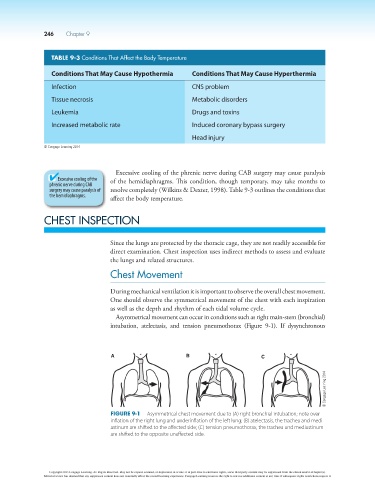
                                             Asymmetrical movement can occur in conditions such as right main-stem (bronchial)
                                            intubation,  atelectasis,  and  tension  pneumothorax  (Figure  9-1).  If  dysynchronous


                                            A                       B                        C


                                                                                                                  © Cengage Learning 2014


                                            Figure 9-1  Asymmetrical chest movement due to (A) right bronchial intubation; note over-
                                            inflation of the right lung and underinflation of the left lung; (B) atelectasis, the trachea and medi-
                                            astinum are shifted to the affected side; (C) tension pneumothorax, the trachea and mediastinum
                                            are shifted to the opposite unaffected side.


                        Copyright 2013 Cengage Learning. All Rights Reserved. May not be copied, scanned, or duplicated, in whole or in part. Due to electronic rights, some third party content may be suppressed from the eBook and/or eChapter(s).
                      Editorial review has deemed that any suppressed content does not materially affect the overall learning experience. Cengage Learning reserves the right to remove additional content at any time if subsequent rights restrictions require it.

