


Page 282 - Clinical Application of Mechanical Ventilation
P. 282
248    Chapter 9


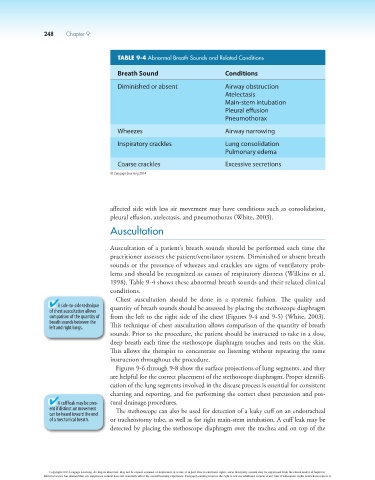
                                              TABLE 9-4 Abnormal Breath Sounds and Related Conditions

                                              Breath Sound                       Conditions

                                              Diminished or absent               Airway obstruction
                                                                                 Atelectasis
                                                                                 Main-stem intubation
                                                                                 Pleural effusion
                                                                                 Pneumothorax
                                              Wheezes                            Airway narrowing

                                              Inspiratory crackles               Lung consolidation
                                                                                 Pulmonary edema

                                              Coarse crackles                    Excessive secretions
                                            © Cengage Learning 2014


                                            affected side with less air movement may have conditions such as consolidation,
                                            pleural effusion, atelectasis, and pneumothorax (White, 2003).
                                            Auscultation


                                            Auscultation of a patient’s breath sounds should be performed each time the
                                            practitioner assesses the patient/ventilator system. Diminished or absent breath
                                            sounds or the presence of wheezes and crackles are signs of ventilatory prob-
                                            lems and should be recognized as causes of respiratory distress (Wilkins et al.
                                            1998). Table 9-4 shows these abnormal breath sounds and their related clinical
                                            conditions.
                                             Chest  auscultation  should  be  done  in  a  systemic  fashion.  The  quality  and
                          A side-to-side technique   quantity of breath sounds should be assessed by placing the stethoscope diaphragm
                        of chest auscultation allows
                        comparison of the quantity of   from the left to the right side of the chest (Figures 9-4 and 9-5) (White, 2003).
                        breath sounds between the
                        left and right lungs.  This technique of chest auscultation allows comparison of the quantity of breath
                                            sounds. Prior to the procedure, the patient should be instructed to take in a slow,
                                            deep breath each time the stethoscope diaphragm touches and rests on the skin.
                                            This allows the therapist to concentrate on listening without repeating the same
                                            instruction throughout the procedure.
                                             Figures 9-6 through 9-8 show the surface projections of lung segments, and they
                                            are helpful for the correct placement of the stethoscope diaphragm. Proper identifi-
                                            cation of the lung segments involved in the disease process is essential for consistent
                                            charting and reporting, and for performing the correct chest percussion and pos-
                          A cuff leak may be pres-  tural drainage procedures.
                        ent if distinct air movement   The stethoscope can also be used for detection of a leaky cuff on an endotracheal
                        can be heard toward the end
                        of a mechanical breath.  or tracheostomy tube, as well as for right main-stem intubation. A cuff leak may be
                                            detected by placing the stethoscope diaphragm over the trachea and on top of the


                        Copyright 2013 Cengage Learning. All Rights Reserved. May not be copied, scanned, or duplicated, in whole or in part. Due to electronic rights, some third party content may be suppressed from the eBook and/or eChapter(s).
                      Editorial review has deemed that any suppressed content does not materially affect the overall learning experience. Cengage Learning reserves the right to remove additional content at any time if subsequent rights restrictions require it.

