


Page 285 - Clinical Application of Mechanical Ventilation
P. 285
Monitoring in Mechanical Ventilation  251


                                             Imaging


                                             The chest radiograph is the most common method to evaluate the conditions
                                             of  the  thoracic  structure,  lungs,  pleural  space,  inserted  catheters,  lines,  and
                                             tubes. Interpretation of the chest radiograph is beyond the scope of this sec-
                                             tion. Readers are encouraged to use additional resources on the fundamentals
                                             and clinical application of chest radiography. This section reviews the normal
                                             posterior-anterior  (PA)  and  lateral  chest  radiographs,  the  major  anatomical
                                             structures on the chest radiograph, and the primary reason for using a lateral
                                             chest radiograph.
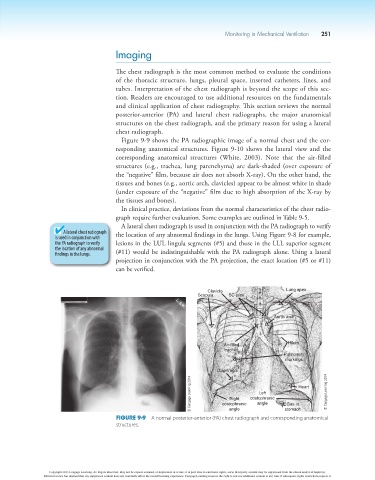
                                               Figure 9-9 shows the PA radiographic image of a normal chest and the cor-
                                             responding anatomical structures. Figure 9-10 shows the lateral view and the
                                             corresponding  anatomical  structures  (White,  2003).  Note  that  the  air-filled
                                             structures (e.g., trachea, lung parenchyma) are dark-shaded (over exposure of
                                             the “negative” film, because air does not absorb X-ray). On the other hand, the
                                             tissues and bones (e.g., aortic arch, clavicles) appear to be almost white in shade
                                             (under exposure of the “negative” film due to high absorption of the X-ray by
                                             the tissues and bones).
                                               In clinical practice, deviations from the normal characteristics of the chest radio-
                                             graph require further evaluation. Some examples are outlined in Table 9-5.
                                               A lateral chest radiograph is used in conjunction with the PA radiograph to verify
                            A lateral chest radiograph   the location of any abnormal findings in the lungs. Using Figure 9-8 for example,
                          is used in conjunction with
                          the PA radiograph to verify   lesions in the LUL lingula segments (#5) and those in the LLL superior segment
                          the location of any abnormal
                          findings in the lungs.  (#11) would be indistinguishable with the PA radiograph alone. Using a lateral
                                             projection in conjunction with the PA projection, the exact location (#5 or #11)
                                             can be verified.


                                                                           Clavicle                  Lung apex
                                                                        Scapula   SC joint


                                                                                                 Aortic arch


                                                                                 Air-filled           Hilum
                                                                                 trachea
                                                                                                    Pulmonary
                                                                                                     markings
                                                                              Diaphragm
                                                                      © Cengage Learning 2014  costophrenic  costophrenic  Gas in Heart  © Cengage Learning 2014

                                                                                            Left
                                                                                  Right
                                                                                            angle
                                                                                                     stomach
                                                                                  angle
                                              Figure 9-9  A normal posterior-anterior (PA) chest radiograph and corresponding anatomical
                                              structures.


                        Copyright 2013 Cengage Learning. All Rights Reserved. May not be copied, scanned, or duplicated, in whole or in part. Due to electronic rights, some third party content may be suppressed from the eBook and/or eChapter(s).
                      Editorial review has deemed that any suppressed content does not materially affect the overall learning experience. Cengage Learning reserves the right to remove additional content at any time if subsequent rights restrictions require it.

