


Page 286 - Clinical Application of Mechanical Ventilation
P. 286
252    Chapter 9


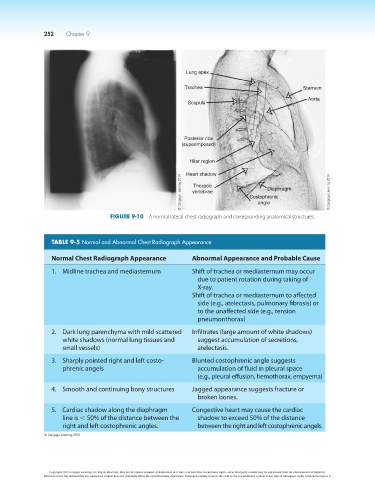
                                                                    Lung apex

                                                                    Trachea                                Sternum

                                                                                                            Aorta
                                                                     Scapula


                                                                    Posterior ribs
                                                                   (superimposed)

                                                                      Hilar region

                                                                    Heart shadow
                                                                   © Cengage Learning 2014  vertebrae  Costophrenic  © Cengage Learning 2014
                                                                       Thoracic
                                                                                               Diaphragm

                                                                                            angle

                                            Figure 9-10  A normal lateral chest radiograph and corresponding anatomical structures.


                        TABLE 9-5 Normal and Abnormal Chest Radiograph Appearance

                        Normal Chest Radiograph Appearance            Abnormal Appearance and Probable Cause

                        1.  Midline trachea and mediasternum          Shift of trachea or mediasternum may occur
                                                                        due to patient rotation during taking of
                                                                        X-ray.
                                                                      Shift of trachea or mediasternum to affected
                                                                        side (e.g., atelectasis, pulmonary fibrosis) or
                                                                        to the unaffected side (e.g., tension
                                                                        pneumonthorax)

                        2.   Dark lung parenchyma with mild scattered   Infiltrates (large amount of white shadows)
                            white shadows (normal lung tissues and      suggest accumulation of secretions,
                            small vessels)                              atelectasis.

                        3.   Sharply pointed right and left costo-    Blunted costophrenic angle suggests
                            phrenic angels                              accumulation of fluid in pleural space
                                                                        (e.g., pleural effusion, hemothorax, empyema)

                        4.   Smooth and continuing bony structures    Jagged appearance suggests fracture or
                                                                        broken bones.

                        5.   Cardiac shadow along the diaphragm       Congestive heart may cause the cardiac
                            line is , 50% of the distance between the   shadow to exceed 50% of the distance
                            right and left costophrenic angles.         between the right and left costophrenic angels.
                      © Cengage Learning 2014


                        Copyright 2013 Cengage Learning. All Rights Reserved. May not be copied, scanned, or duplicated, in whole or in part. Due to electronic rights, some third party content may be suppressed from the eBook and/or eChapter(s).
                      Editorial review has deemed that any suppressed content does not materially affect the overall learning experience. Cengage Learning reserves the right to remove additional content at any time if subsequent rights restrictions require it.

