


Page 39 - Clinical Application of Mechanical Ventilation
P. 39
Principles of Mechanical Ventilation  5


                                             in minute ventilation. This is because airway resistance and flow in the equation are
                                             inversely related. In a clinical setting, hypoventilation may result if the patient is
                        hypoventilation: Inadequacy
                        of  ventilation to remove CO 2 . The   unable to overcome the airway resistance by increasing the work of breathing.
                        arterial PCO 2  is elevated in condi-  As a result of chronic air trapping, patients with chronic airway obstruction may
                        tions of hypoventilation.
                                             develop highly compliant lung parenchyma. These patients use a breathing pattern
                                             that is deeper but slower. On the other hand, patients with restrictive lung disease
                                             (low compliance) breathe more shallowly but faster, since airflow resistance is not
                                             the primary disturbance in these patients.

                        ventilatory failure: Failure of
                        the respiratory system to remove   Effects on Ventilation and Oxygenation
                        CO 2  from the body resulting in an
                        abnormally high PaCO 2 .
                                             The work of breathing imposed on a patient is increased when airway resistance is
                                             high. This creates a detrimental effect on the patient’s ventilatory and oxygenation
                        oxygenation failure: Failure   status. If an abnormally high airway resistance is sustained over a long time, fatigue
                        of the heart and lungs to provide
                        adequate oxygen for metabolic   of the respiratory muscles may occur, leading to ventilatory and oxygenation failure
                        needs.
                                             (Rochester, 1993). Ventilatory failure occurs when the patient’s minute ventilation
                                             cannot keep up with CO  production. Oxygenation failure usually follows when
                                                                   2
                                             the cardiopulmonary system cannot provide adequate oxygen needed for metabolism.
                            An increased bowing
                          of the P-V loop suggests an
                          overall increase in airflow
                          resistance.        Airflow Resistance

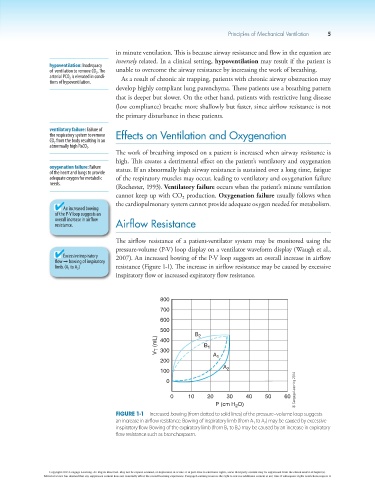
                                             The  airflow  resistance  of  a  patient-ventilator  system  may  be  monitored  using  the
                                             pressure-volume (P-V) loop display on a ventilator waveform display (Waugh et al.,
                            Excessive inspiratory    2007). An increased bowing of the P-V loop suggests an overall increase in airflow
                          flow ➞ bowing of inspiratory
                          limb. (A 1  to A 2 )  resistance (Figure 1-1). The increase in airflow resistance may be caused by excessive
                                             inspiratory flow or increased expiratory flow resistance.


                                                            800

                                                            700
                                                            600
                                                            500
                                                                       B 2
                                                           V T  (mL)  400  B 1
                                                            300
                                                            200              A 1
                                                                                A
                                                            100                   2
                                                              0

                                                               0     10    20     30    40    50    60  © Cengage Learning 2014
                                                                              P (cm H 2 O)
                                             Figure 1-1  Increased bowing (from dotted to solid lines) of the pressure–volume loop suggests
                                             an increase in airflow resistance. Bowing of inspiratory limb (from A 1  to A 2 ) may be caused by excessive
                                             inspiratory flow. Bowing of the expiratory limb (from B 1  to B 2 ) may be caused by an increase in expiratory
                                             flow resistance such as bronchospasm.


                        Copyright 2013 Cengage Learning. All Rights Reserved. May not be copied, scanned, or duplicated, in whole or in part. Due to electronic rights, some third party content may be suppressed from the eBook and/or eChapter(s).
                      Editorial review has deemed that any suppressed content does not materially affect the overall learning experience. Cengage Learning reserves the right to remove additional content at any time if subsequent rights restrictions require it.

