


Page 41 - Clinical Application of Mechanical Ventilation
P. 41
Principles of Mechanical Ventilation  7


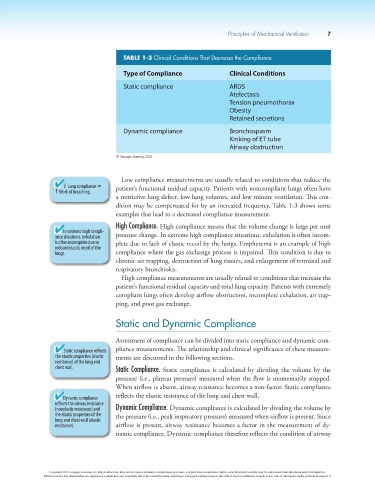
                                                TABLE 1-3 Clinical Conditions That Decrease the Compliance

                                                Type of Compliance                 Clinical Conditions

                                                Static compliance                  ARDS
                                                                                   Atelectasis
                                                                                   Tension pneumothorax
                                                                                   Obesity
                                                                                   Retained secretions
                                                Dynamic compliance                 Bronchospasm
                                                                                   Kinking of ET tube
                                                                                   Airway obstruction

                                              © Cengage Learning 2014


                                               Low compliance measurements are usually related to conditions that reduce the
                            ➞  Lung compliance 5
                                             patient’s functional residual capacity. Patients with noncompliant lungs often have
                           ➞   Work of breathing.
                                             a restrictive lung defect, low lung volumes, and low minute ventilation. This con-
                                             dition may be compensated for by an increased frequency. Table 1-3 shows some
                                             examples that lead to a decreased compliance measurement.
                                             High Compliance. High compliance means that the volume change is large per unit
                            In extreme high compli-
                          ance situations, exhalation   pressure change. In extreme high compliance situations, exhalation is often incom-
                          is often incomplete due to   plete due to lack of elastic recoil by the lungs. Emphysema is an example of high
                          reduced elastic recoil of the
                          lungs.             compliance where the gas exchange process is impaired. This condition is due to
                                             chronic air trapping, destruction of lung tissues, and enlargement of terminal and
                                             respiratory bronchioles.
                                               High compliance measurements are usually related to conditions that increase the
                                             patient’s functional residual capacity and total lung capacity. Patients with extremely
                                             compliant lungs often develop airflow obstruction, incomplete exhalation, air trap-
                                             ping, and poor gas exchange.


                                             Static and Dynamic Compliance


                                             Assessment of compliance can be divided into static compliance and dynamic com-
                            Static compliance reflects   pliance measurements. The relationship and clinical significance of these measure-
                          the elastic properties (elastic   ments are discussed in the following sections.
                          resistance) of the lung and
                          chest wall.        Static Compliance. Static compliance is calculated by dividing the volume by the
                                             pressure (i.e., plateau pressure) measured when the flow is momentarily stopped.
                                             When airflow is absent, airway resistance becomes a non-factor. Static compliance
                                             reflects the elastic resistance of the lung and chest wall.
                            Dynamic compliance
                          reflects the airway resistance
                          (nonelastic resistance) and   Dynamic Compliance. Dynamic compliance is calculated by dividing the volume by
                          the elastic properties of the   the pressure (i.e., peak inspiratory pressure) measured when airflow is present. Since
                          lung and chest wall (elastic
                          resistance).       airflow is present, airway resistance becomes a factor in the measurement of dy-
                                             namic compliance. Dynamic compliance therefore reflects the condition of airway


                        Copyright 2013 Cengage Learning. All Rights Reserved. May not be copied, scanned, or duplicated, in whole or in part. Due to electronic rights, some third party content may be suppressed from the eBook and/or eChapter(s).
                      Editorial review has deemed that any suppressed content does not materially affect the overall learning experience. Cengage Learning reserves the right to remove additional content at any time if subsequent rights restrictions require it.

