


Page 40 - Clinical Application of Mechanical Ventilation
P. 40
6      Chapter 1


                                             When the inspiratory flow exceeds a patient’s tidal volume and inspiratory time
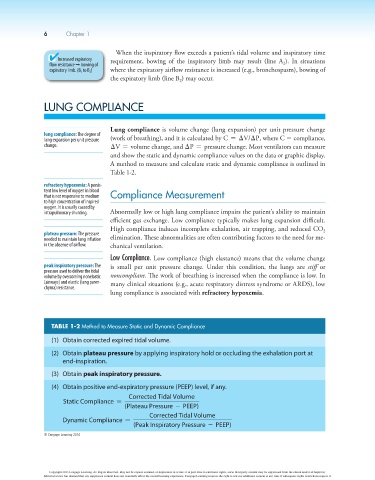
                          Increased expiratory   requirement,  bowing  of  the  inspiratory  limb  may  result  (line  A ).  In  situations
                        flow resistance ➞ bowing of                                                 2
                        expiratory limb. (B 1  to B 2 )  where the expiratory airflow resistance is increased (e.g., bronchospasm), bowing of
                                            the expiratory limb (line B ) may occur.
                                                                  2


                      LUNG COMPLIANCE


                                            Lung compliance is volume change (lung expansion) per unit pressure change
                      lung compliance: The degree of
                      lung expansion per unit pressure   (work of breathing), and it is calculated by C = DV/DP, where C 5 compliance,
                      change.               DV = volume change, and DP = pressure change. Most ventilators can measure
                                            and show the static and dynamic compliance values on the data or graphic display.
                                            A method to measure and calculate static and dynamic compliance is outlined in
                                            Table 1-2.

                      refractory hypoxemia: A persis-
                      tent low level of oxygen in blood
                      that is not responsive to medium   Compliance Measurement
                      to high concentration of inspired
                      oxygen. It is usually caused by
                      intrapulmonary shunting.  Abnormally low or high lung compliance impairs the patient’s ability to maintain
                                            efficient gas exchange. Low compliance typically makes lung expansion difficult.
                                            High compliance induces incomplete exhalation, air trapping, and reduced CO
                      plateau pressure: The pressure                                                             2
                      needed to maintain lung inflation   elimination. These abnormalities are often contributing factors to the need for me-
                      in the absence of airflow.  chanical ventilation.

                                            Low Compliance. Low compliance (high elastance) means that the volume change
                      peak inspiratory pressure: The   is  small  per  unit  pressure  change.  Under  this  condition,  the  lungs  are  stiff  or
                      pressure used to deliver the tidal
                      volume by overcoming nonelastic   noncompliant. The work of breathing is increased when the compliance is low. In
                      (airways) and elastic (lung paren-  many clinical situations (e.g., acute respiratory distress syndrome or ARDS), low
                      chyma) resistance.
                                            lung compliance is associated with refractory hypoxemia.


                        TABLE 1-2 Method to Measure Static and Dynamic Compliance

                        (1)  Obtain corrected expired tidal volume.
                        (2)   Obtain plateau pressure by applying inspiratory hold or occluding the exhalation port at
                            end-inspiration.

                        (3)  Obtain peak inspiratory pressure.
                        (4)  Obtain positive end-expiratory pressure (PEEP) level, if any.
                                                  Corrected Tidal Volume
                            Static Compliance =
                                                (Plateau Pressure - PEEP)
                                                        Corrected Tidal Volume
                            Dynamic Compliance =
                                                   (Peak Inspiratory Pressure - PEEP)
                      © Cengage Learning 2014


                        Copyright 2013 Cengage Learning. All Rights Reserved. May not be copied, scanned, or duplicated, in whole or in part. Due to electronic rights, some third party content may be suppressed from the eBook and/or eChapter(s).
                      Editorial review has deemed that any suppressed content does not materially affect the overall learning experience. Cengage Learning reserves the right to remove additional content at any time if subsequent rights restrictions require it.

