


Page 409 - Clinical Application of Mechanical Ventilation
P. 409
Management of Mechanical Ventilation  375


                                               	 Identify the normal values and describe methods to provide normal fluid
                                                balance, electrolyte balance, and nutrition.
                                               	 Describe the rationale and procedure to initiate: low tidal volume, prone
                                                positioning, and tracheal gas insufflations.

                        INTRODUCTION


                                             The primary function of mechanical ventilation is to support the ventilatory and oxygen-
                                             ation requirement of a patient until such time that the patient becomes self-sufficient.
                                             During mechanical ventilation, it is essential to maintain a patient’s acid-base balance,
                                             nutritional and resting needs, and fluid and electrolyte balance, because these factors
                                             can affect management strategies of mechanical ventilation and patient outcome.
                                               This chapter discusses strategies to provide optimal ventilation and oxygenation
                                             during mechanical ventilation, as well as other methods to maintain essential physi-
                                             ologic functions through nutritional, fluid, and electrolyte support.


                        BASIC MANAGEMENT STRATEGIES


                                             The	primary	goals	of	mechanical	ventilation	are	to	improve	ventilation	and	oxygen-
                                             ation.	Essentially	all	ventilators	incorporate	designs	and	features	with	these	two	goals
                                             in	mind.	Besides	the	many	modes	of	ventilation	that	are	available,	common	settings
                                             that	are	available	in	most	ventilators	include	frequency	(f),	tidal	volume	(V ),	fraction
                                                                                                           T
                                             of	inspired	oxygenation	concentration	(F O ),	positive	end-expiratory	pressure	(PEEP),
                                                                              I
                                                                                 2
                                             pressure	support	ventilation	(PSV),	and	pressure	gradient	(DP).	These	settings	and
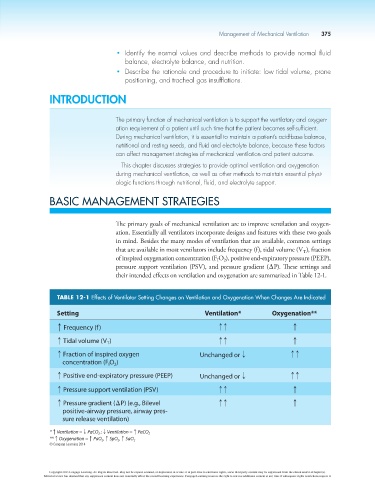
                                             their	intended	effects	on	ventilation	and	oxygenation	are	summarized	in	Table	12-1.


                          TABLE 12-1 Effects of Ventilator Setting Changes on Ventilation and Oxygenation When Changes Are Indicated

                          Setting                                         Ventilation*          Oxygenation**

                          c Frequency (f)                                      c c                     c

                          c Tidal volume (V )                                  c c                     c
                                           T
                          c Fraction of inspired oxygen                  Unchanged or T                c c
                            concentration (F O )
                                           I
                                             2
                          c  Positive end-expiratory pressure (PEEP)     Unchanged or T                c c

                          c Pressure support ventilation (PSV)                 c c                     c

                          c Pressure gradient (DP) (e.g., Bilevel              c c                     c
                            positive-airway pressure, airway pres-
                            sure release ventilation)

                        * c Ventilation = T PaCO 2  ; T Ventilation = c PaCO 2
                        ** c Oxygenation = c PaO 2 , c SpO 2 , c SaO 2
                        © Cengage Learning 2014


                        Copyright 2013 Cengage Learning. All Rights Reserved. May not be copied, scanned, or duplicated, in whole or in part. Due to electronic rights, some third party content may be suppressed from the eBook and/or eChapter(s).
                      Editorial review has deemed that any suppressed content does not materially affect the overall learning experience. Cengage Learning reserves the right to remove additional content at any time if subsequent rights restrictions require it.

