


Page 414 - Clinical Application of Mechanical Ventilation
P. 414
380    Chapter 12


                      STRATEGIES TO IMPROVE OXYGENATION


                                            Oxygenation	is	dependent	on	adequate	and	well-balanced	ventilation,	diffusion,
                      oxygenation: Amount of oxygen
                      available for metabolic functions;   and	perfusion.	The	strategies	to	improve	oxygenation	are	therefore	structured	to
                      affected by ventilation, diffusion   improve	the	normal	physiologic	functions	or	to	compensate	for	the	abnormal	ones.
                      and perfusion.
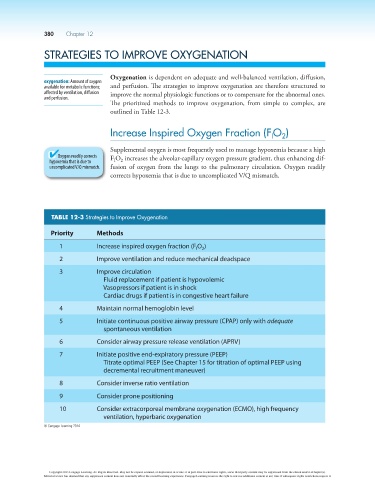
                                            The	 prioritized	 methods	 to	 improve	 oxygenation,	 from	 simple	 to	 complex,	 are
                                            outlined	in	Table	12-3.


                                            Increase Inspired Oxygen Fraction (F O )
                                                                                                I
                                                                                                    2
                                            Supplemental	oxygen	is	most	frequently	used	to	manage	hypoxemia	because	a	high
                          Oxygen readily corrects   F O 	increases	the	alveolar-capillary	oxygen	pressure	gradient,	thus	enhancing	dif-
                        hypoxemia that is due to   I  2
                        uncomplicated V/Q mismatch.  fusion	of	oxygen	from	the	lungs	to	the	pulmonary	circulation.	Oxygen	readily
                                            corrects	hypoxemia	that	is	due	to	uncomplicated	V/Q	mismatch.


                        TABLE 12-3 Strategies to Improve Oxygenation

                        Priority       Methods

                           1           Increase inspired oxygen fraction (F O )
                                                                        I
                                                                          2
                           2           Improve ventilation and reduce mechanical deadspace
                           3           Improve circulation
                                         Fluid replacement if patient is hypovolemic
                                         Vasopressors if patient is in shock
                                         Cardiac drugs if patient is in congestive heart failure
                           4           Maintain normal hemoglobin level

                           5           Initiate continuous positive airway pressure (CPAP) only with adequate
                                         spontaneous ventilation

                           6           Consider airway pressure release ventilation (APRV)

                           7           Initiate positive end-expiratory pressure (PEEP)
                                         Titrate optimal PEEP (See Chapter 15 for titration of optimal PEEP using
                                         decremental recruitment maneuver)

                           8           Consider inverse ratio ventilation
                           9           Consider prone positioning

                           10          Consider extracorporeal membrane oxygenation (ECMO), high frequency
                                         ventilation, hyperbaric oxygenation
                      © Cengage Learning 2014


                        Copyright 2013 Cengage Learning. All Rights Reserved. May not be copied, scanned, or duplicated, in whole or in part. Due to electronic rights, some third party content may be suppressed from the eBook and/or eChapter(s).
                      Editorial review has deemed that any suppressed content does not materially affect the overall learning experience. Cengage Learning reserves the right to remove additional content at any time if subsequent rights restrictions require it.

