


Page 410 - Clinical Application of Mechanical Ventilation
P. 410
376    Chapter 12


                      STRATEGIES TO IMPROVE VENTILATION


                                            Hypoventilation	causes	respiratory	acidosis	(ventilatory	failure)	and	hypoxemia
                          PaCO 2  .45 mm Hg is   if	 supplemental	 oxygen	 is	 not	 provided	 to	 the	 patient.	 The	 best	 measure	 of
                        indicative of hypoventilation
                        (the normal PaCO 2  for COPD   a	patient’s	ventilatory	status	is	the	PaCO 	level.	The	normal	PaCO 	is	35	to
                                                                                                         2
                                                                                 2
                        patients is about 50 mm Hg).  45	mm	Hg;	PaCO 	greater	than	45	mm	Hg	is	indicative	of	hypoventilation.
                                                             2
                                            For	 COPD	 patients,	 however,	 the	 acceptable	 PaCO 	 should	 be	 the	 patient’s
                                                                                           2
                                            normal	value	upon	last	hospital	discharge,	and	generally	it	is	about	50	mm	Hg.
                                            When	the	PaCO 	level	goes	above	this	value,	significant	hypoventilation	may
                                                           2
                                            be	present.
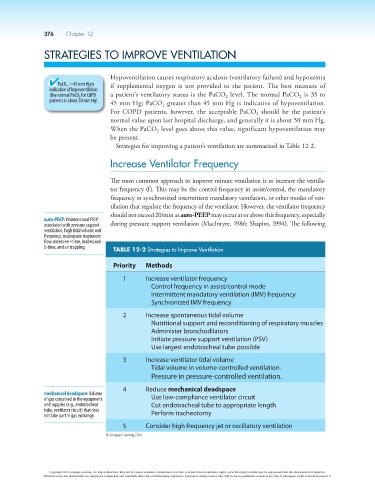
                                             Strategies	for	improving	a	patient’s	ventilation	are	summarized	in	Table	12-2.
                                            Increase Ventilator Frequency


                                            The	most	common	approach	to	improve	minute	ventilation	is	to	increase	the	ventila-
                                            tor	frequency	(f	).	This	may	be	the	control	frequency	in	assist/control,	the	mandatory
                                            frequency	in	synchronized	intermittent	mandatory	ventilation,	or	other	modes	of	ven-
                                            tilation	that	regulate	the	frequency	of	the	ventilator.	However,	the	ventilator	frequency
                                            should	not	exceed	20/min	as	auto-PEEP	may	occur	at	or	above	this	frequency,	especially
                      auto-PEEP: Unintentional PEEP
                      associated with pressure support   during	pressure	support	ventilation	(MacIntyre,	1986;	Shapiro,	1994).	The	following
                      ventilation, high tidal volume and
                      frequency, inadequate inspiratory
                      flow, excessive I-time, inadequate
                      E-time, and air trapping.  TABLE 12-2 Strategies to Improve Ventilation


                                             Priority  Methods
                                                1      Increase ventilator frequency
                                                         Control frequency in assist/control mode
                                                         Intermittent mandatory ventilation (IMV) frequency
                                                         Synchronized IMV frequency

                                                2      Increase spontaneous tidal volume
                                                         Nutritional support and reconditioning of respiratory muscles
                                                         Administer bronchodilators
                                                         Initiate pressure support ventilation (PSV)
                                                         Use largest endotracheal tube possible

                                                3      Increase ventilator tidal volume
                                                         Tidal volume in volume-controlled ventilation.
                                                         Pressure in pressure-controlled ventilation.

                                                4      Reduce mechanical deadspace
                      mechanical deadspace: Volume
                      of gas contained in the equipment   Use low-compliance ventilator circuit
                      and supplies (e.g., endotracheal   Cut endotracheal tube to appropriate length
                      tube, ventilator circuit) that does   Perform tracheotomy
                      not take part in gas exchange.
                                                5      Consider high frequency jet or oscillatory ventilation
                                          © Cengage Learning 2014


                        Copyright 2013 Cengage Learning. All Rights Reserved. May not be copied, scanned, or duplicated, in whole or in part. Due to electronic rights, some third party content may be suppressed from the eBook and/or eChapter(s).
                      Editorial review has deemed that any suppressed content does not materially affect the overall learning experience. Cengage Learning reserves the right to remove additional content at any time if subsequent rights restrictions require it.

