


Page 413 - Clinical Application of Mechanical Ventilation
P. 413
Management of Mechanical Ventilation  379


                                             2002).	 Permissive	 hypercapnia	 is	 done	 by	 using	 a	 low	 ventilator	 tidal	 volume
                                             in	the	range	of	4–7	mL/kg	(normally	10	mL/kg)	(Feihl	et	al.,	1994).	The	re-
                                             duced	tidal	volume	lowers	the	peak	inspiratory	pressure	and	minimizes	pressure-
                                             or	volume-related	complications.	Since	the	plateau	pressure	(i.e.,	end-inspiratory
                            The plateau pressure   occlusion	pressure)	is	the	best	estimate	of	the	average	peak	alveolar	pressure,	it
                          should be kept below at or
                          35 cm H 2 O to avoid pressure-  is	often	used	as	the	target	pressure	when	trying	to	avoid	alveolar	overdistention
                          induced lung injuries.  (Slutsky,	1994).	The	ventilator	tidal	volume	may	be	titrated	to	keep	the	plateau
                                             pressure	at	or	below	35	cm	H O.
                                                                       2
                                               Low	 tidal	 volume	 may	 cause	 hypoventilation,	 CO 	 retention,	 and	 acidosis.
                                                                                             2
                                             Acidosis	leads	to	development	of	central	nervous	dysfunction,	intracranial	hyperten-
                                             sion,	neuromuscular	weakness,	cardiovascular	impairment,	and	increased	pulmo-
                                             nary	vascular	resistance.	These	potential	complications	may	be	alleviated	by	keeping
                                             the	pH	within	its	normal	range	(7.35–7.45),	either	by	renal	compensation	over	time
                                             or	by	neutralizing	the	acid	with	bicarbonate	or	tromethamine	(Marini,	1993).
                                               Tromethamine	(THAM)	is	a	nonbicarbonate	buffer	that	helps	to	compensate	for
                                             metabolic	acidosis.	THAM	directly	decreases	the	hydrogen	ion	concentration	and
                            Tromethamine (THAM)   indirectly	decreases	the	carbon	dioxide	level.	The	beneficial	result	is	an	increased
                          lowers the carbon dioxide   bicarbonate	 level.	 Because	 of	 its	 lowering	 effect	 on	 the	 carbon	 dioxide	 level,
                          level and increases the bicar-
                          bonate levels. It is preferable   tromethamine	may	be	preferable	to	bicarbonate	in	patients	who	are	being	managed
                          to bicarbonate in patients   with	permissive	hypercapnia	(Kallet	et	al.,	2000).	Dosage	of	0.3	M	tromethamine
                          undergoing permissive
                          hypercapnia.       needed	to	compensate	for	metabolic	acidosis	is	calculated	by:	body	weight	in	Kg	3
                                             base	deficit	in	mEq/L.	Side	effects	of	tromethamine	include	transient	hypoglycemia,
                                             respiratory	depression,	and	hemorrhagic	hepatic	necrosis	(Nahas	et	al.,	1998).
                                               By	normalizing	the	pH,	it	appears	that	permissive	hypercapnia	may	be	a	safe	and
                                             beneficial	strategy	in	the	management	of	patients	with	status	asthmaticus	(Cox	et	al.,
                                             1991;	Darioli	et	al.,	1984),	and	adult	respiratory	distress	syndrome	(ARDS)	(Feihl
                                             et	al.,	1994;	Hickling	et	al.,	1990;	Lewandowski	et	al.,	1992).	The	mechanism	and
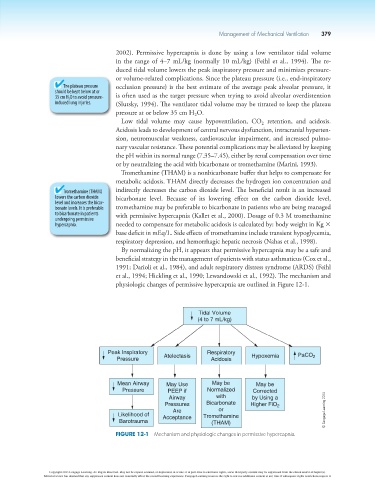
                                             physiologic	changes	of	permissive	hypercapnia	are	outlined	in	Figure	12-1.


                                                                        Tidal Volume
                                                                        (4 to 7 mL/kg)


                                           Peak Inspiratory                Respiratory
                                              Pressure       Atelectasis    Acidosis      Hypoxemia      PaCO 2


                                              Mean Airway     May Use        May be        May be
                                                Pressure      PEEP if      Normalized     Corrected
                                                               Airway         with        by Using a
                                                             Pressures     Bicarbonate   Higher FiO 2
                                                                Are            or                                 © Cengage Learning 2014
                                              Likelihood of  Acceptance   Tromethamine
                                              Barotrauma                     (THAM)

                                             Figure 12-1  Mechanism and physiologic changes in permissive hypercapnia.


                        Copyright 2013 Cengage Learning. All Rights Reserved. May not be copied, scanned, or duplicated, in whole or in part. Due to electronic rights, some third party content may be suppressed from the eBook and/or eChapter(s).
                      Editorial review has deemed that any suppressed content does not materially affect the overall learning experience. Cengage Learning reserves the right to remove additional content at any time if subsequent rights restrictions require it.

