


Page 525 - Clinical Application of Mechanical Ventilation
P. 525
Critical Care Issues in Mechanical Ventilation  491


                                             normal  compliant  lung  units  are  mingled  with  collapsed  noncompliant  lung
                        acute respiratory distress
                        syndrome (ARDS): A condition   units.  When  these  lungs  are  ventilated  by  positive  pressure,  the  noncompliant
                        of sudden onset, characterized   units  are  recruited  intermittently  while  the  compliant  units  suffer  from  overdis-
                        by non-cardiogenic pulmonary
                        edema on chest radiograph and a   tention. As early as 1970, a study showed that when a peak transalveolar pressure
                        PaO 2 /F I O 2  of # 200 mm Hg.
                                             of 30 cm H O was applied to the nonhomogenous lung units, the stress on the
                                                        2
                                             wall between normal and collapsed units reached 140 cm H O (Mead, 1970). This
                                                                                                2
                                             pressure  harms  the  compliant  lung  unit  since  they  cannot  sustain  extreme  high
                                             pressures.
                            When non-homogenous
                          lungs are ventilated by
                          positive pressure, the non-
                          compliant units are recruited   Definitions of ALI and ARDS
                          intermittently while the
                          compliant units suffer from
                          over-distention.   Acute respiratory distress syndrome (ARDS) is a more severe form of acute lung
                                             injury (ALI). The mortality rate of patients with ARDS ranges from 10% to 90%.
                                             This wide range may be attributed to the nonuniformity of the disease processes,
                                             definition  for  ARDS,  therapy  modality,  and  patient  population.  In  1992,  the
                                             American-European Consensus Conference on ARDS recommended four evalu-
                                             ation parameters for the classification of ALI and ARDS. These parameters are
                                             timing of onset, oxygenation, chest radiograph, and pulmonary capillary wedge
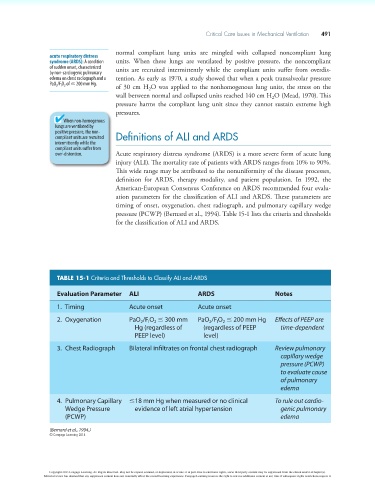
                                             pressure (PCWP) (Bernard et al., 1994). Table 15-1 lists the criteria and thresholds
                                             for the classification of ALI and ARDS.


                          TABLE 15-1 Criteria and Thresholds to Classify ALI and ARDS

                          Evaluation Parameter    ALI                   ARDS                     Notes

                          1.  Timing              Acute onset           Acute onset
                          2.  Oxygenation         PaO /F O  # 300 mm    PaO /F O  # 200 mm Hg    Effects of PEEP are
                                                                              I
                                                                                2
                                                     2
                                                        I
                                                          2
                                                                            2
                                                    Hg (regardless of     (regardless of PEEP      time-dependent
                                                    PEEP level)           level)
                          3.  Chest Radiograph    Bilateral infiltrates on frontal chest radiograph  Review pulmonary
                                                                                                   capillary wedge
                                                                                                   pressure (PCWP)
                                                                                                   to evaluate cause
                                                                                                   of pulmonary
                                                                                                   edema

                          4.   Pulmonary Capillary  #18 mm Hg when measured or no clinical       To rule out cardio-
                             Wedge Pressure         evidence of left atrial hypertension           genic pulmonary
                             (PCWP)                                                                edema

                        (Bernard et al., 1994.)
                        © Cengage Learning 2014


                        Copyright 2013 Cengage Learning. All Rights Reserved. May not be copied, scanned, or duplicated, in whole or in part. Due to electronic rights, some third party content may be suppressed from the eBook and/or eChapter(s).
                      Editorial review has deemed that any suppressed content does not materially affect the overall learning experience. Cengage Learning reserves the right to remove additional content at any time if subsequent rights restrictions require it.

