


Page 526 - Clinical Application of Mechanical Ventilation
P. 526
492    Chapter 15


                                             The criteria for ALI and ARDS are same with the exception of the PaO /F O values
                                                                                                          I
                                                                                                       2
                                                                                                            2
                          ARDS is a more severe   (#300 mm Hg for ALI and #200 mm Hg for ARDS—regardless of PEEP level
                        form of ALI. The PaO 2 /F I O 2
                        threshold for ALI is # 300   for ALI and ARDS). When using the PaO /F O as an evaluation tool for ALI and
                                                                                    2
                                                                                2
                                                                                  I
                        mm Hg, and for ARDS it is
                        # 200 mm Hg.        ARDS, it is essential to consider other conditions that may contribute to the decrease
                                            of PaO /F O . For example, hypoventilation can lower the PaO  and PaO /F O .
                                                 2
                                                                                                             2
                                                    I
                                                                                                2
                                                                                                         2
                                                      2
                                                                                                           I
                                            Pathophysiology
                                            The alveolar-capillary membrane consists of the alveolar epithelium and the vascu-
                          Direct injury to the lungs
                        can lead to pathological ab-  lar endothelium. Research studies have shown that damage to the lungs can occur
                        normality in the intra-alveolar
                        space and alveolar filling   on either side of the membrane.
                        by edema, fibrin, collagen,
                        neutrophilic aggregates, or   Direct Injury. Exposure of alveolar epithelium to direct insult (e.g., bacteria) leads
                        blood.              to activation of alveolar macrophages and development of inflammatory response
                                            within the lungs. Furthermore, alveolar epithelial damage can lead to pathological
                                            abnormality in the intra-alveolar space and alveolar filling by edema, fibrin, col-
                                            lagen, neutrophilic aggregates, or blood (Johanson et al., 1985; Paolo et al., 1993;
                          Indirect injury to the
                        lungs primarily lead to   Rocco et al., 2008). The radiographic signs of ALI typically show infiltrates and
                        microvascular congestion
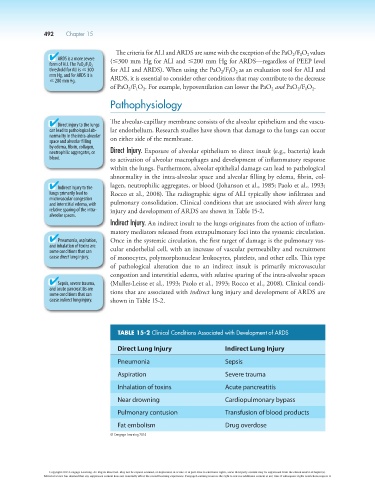
                        and interstitial edema, with   pulmonary consolidation. Clinical conditions that are associated with direct lung
                        relative sparing of the intra-  injury and development of ARDS are shown in Table 15-2.
                        alveolar spaces.
                                            Indirect Injury. An indirect insult to the lungs originates from the action of inflam-
                                            matory mediators released from extrapulmonary foci into the systemic circulation.
                          Pneumonia, aspiration,   Once in the systemic circulation, the first target of damage is the pulmonary vas-
                        and inhalation of toxins are
                        some conditions that can   cular endothelial cell, with an increase of vascular permeability and recruitment
                        cause direct lung injury.  of monocytes, polymorphonuclear leukocytes, platelets, and other cells. This type
                                            of  pathological  alteration  due  to  an  indirect  insult  is  primarily  microvascular
                                            congestion and interstitial edema, with relative sparing of the intra-alveolar spaces
                          Sepsis, severe trauma,   (Muller-Leisse et al., 1993; Paolo et al., 1993; Rocco et al., 2008). Clinical condi-
                        and acute pancreatitis are
                        some conditions that can   tions that are associated with indirect lung injury and development of ARDS are
                        cause indirect lung injury.  shown in Table 15-2.


                                              TABLE 15-2 Clinical Conditions Associated with Development of ARDS

                                              Direct Lung Injury                 Indirect Lung Injury

                                              Pneumonia                          Sepsis

                                              Aspiration                         Severe trauma
                                              Inhalation of toxins               Acute pancreatitis

                                              Near drowning                      Cardiopulmonary bypass

                                              Pulmonary contusion                Transfusion of blood products
                                              Fat embolism                       Drug overdose
                                            © Cengage Learning 2014


                        Copyright 2013 Cengage Learning. All Rights Reserved. May not be copied, scanned, or duplicated, in whole or in part. Due to electronic rights, some third party content may be suppressed from the eBook and/or eChapter(s).
                      Editorial review has deemed that any suppressed content does not materially affect the overall learning experience. Cengage Learning reserves the right to remove additional content at any time if subsequent rights restrictions require it.

