


Page 530 - Clinical Application of Mechanical Ventilation
P. 530
496    Chapter 15


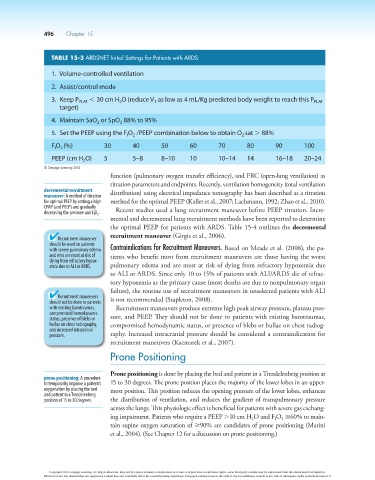
                        TABLE 15-3 ARDSnET Initial Settings for Patients with ARDS

                        1.  Volume-controlled ventilation

                        2.  Assist/control mode

                        3.   Keep P PLAT  , 30 cm H O (reduce V  as low as 4 mL/Kg predicted body weight to reach this P PLAT
                                               2
                                                          T
                           target)
                        4.  Maintain SaO  or SpO  88% to 95%
                                       2
                                               2
                        5.   Set the PEEP using the F O  /PEEP combination below to obtain O sat . 88%
                                                   2
                                                                                       2
                                                 I
                        F O (%)           30       40       50        60       70       80        90       100
                         I
                           2
                        PEEP (cm H O)     5        5–8      8–10      10       10–14    14        16–18    20–24
                                   2
                      © Cengage Learning 2014
                                            function (pulmonary oxygen transfer efficiency), and FRC (open-lung ventilation) as
                                            titration parameters and endpoints. Recently, ventilation homogeneity (total ventilation
                      decremental recruitment   distribution) using electrical impedance tomography has been described as a titration
                      maneuver: A method of titration
                      for optimal PEEP by setting a high   method for the optimal PEEP (Kallet et al., 2007; Lachmann, 1992; Zhao et al., 2010).
                      CPAP (and PEEP) and gradually
                      decreasing the pressure and F I O 2 .   Recent studies used a lung recruitment maneuver before PEEP titration. Incre-
                                            mental and decremental lung recruitment methods have been reported to determine
                                            the optimal PEEP for patients with ARDS. Table 15-4 outlines the decremental
                                            recruitment maneuver (Girgis et al., 2006).
                          Recruitment maneuver
                        should be used on patients
                        with severe pulmonary edema   Contraindications for Recruitment Maneuvers. Based on Meade et al. (2008), the pa-
                        and who are most at risk of   tients who benefit most from recruitment maneuvers are those having the worst
                        dying from refractory hypox-
                        emia due to ALI or ARDS.  pulmonary edema and are most at risk of dying from refractory hypoxemia due
                                            to ALI or ARDS. Since only 10 to 15% of patients with ALI/ARDS die of refrac-
                                            tory hypoxemia as the primary cause (most deaths are due to nonpulmonary organ
                                            failure), the routine use of recruitment maneuvers in unselected patients with ALI
                          Recruitment maneuvers   is not recommended (Stapleton, 2008).
                        should not be done to patients
                        with existing barotraumas,   Recruitment maneuvers produce extreme high peak airway pressure, plateau pres-
                        compromised hemodynamic
                        status, presence of blebs or   sure, and PEEP. They should not be done to patients with existing barotraumas,
                        bullae on chest radiography,   compromised hemodynamic status, or presence of blebs or bullae on chest radiog-
                        and increased intracranial
                        pressure.           raphy. Increased intracranial pressure should be considered a contraindication for
                                            recruitment maneuvers (Kacmarek et al., 2007).

                                            Prone Positioning


                                            Prone positioning is done by placing the bed and patient in a Trendelenberg position at
                      prone positioning: A procedure
                      to temporarily improve a patient’s   15 to 30 degrees. The prone position places the majority of the lower lobes in an upper-
                      oxygenation by placing the bed   most position. This position reduces the opening pressure of the lower lobes, enhances
                      and patient in a Trendelenberg
                      position at 15 to 30 degrees.  the distribution of ventilation, and reduces the gradient of transpulmonary pressure
                                            across the lungs. This physiologic effect is beneficial for patients with severe gas exchang-
                                            ing impairment. Patients who require a PEEP .10 cm H O and F O  $60% to main-
                                                                                                   2
                                                                                                 I
                                                                                          2
                                            tain supine oxygen saturation of $90% are candidates of prone positioning (Marini
                                            et al., 2004). (See Chapter 12 for a discussion on prone positioning.)


                        Copyright 2013 Cengage Learning. All Rights Reserved. May not be copied, scanned, or duplicated, in whole or in part. Due to electronic rights, some third party content may be suppressed from the eBook and/or eChapter(s).
                      Editorial review has deemed that any suppressed content does not materially affect the overall learning experience. Cengage Learning reserves the right to remove additional content at any time if subsequent rights restrictions require it.

