


Page 527 - Clinical Application of Mechanical Ventilation
P. 527
Critical Care Issues in Mechanical Ventilation  493


                                               Treatment modalities for many critical conditions tend to target corrections of the
                                             underlying causes (e.g., antibiotics for infection). At the present time, the best known
                                             and most common management strategy for ALI and ARDS is supportive care for
                                             oxygenation and ventilation. Studies on lung injury have identified risk factors and
                                             have suggested that certain critical care interventions may influence the incidence of
                                             lung injury. In the future, a well-designed screening tool or a lung injury predictive
                                             model may help to reduce the incidence of ALI and ARDS (Litell et al., 2011).


                                             Clinical Presentations


                                             In the early stage of ARDS, the clinical signs may include tachypnea, tachycardia,
                            A combination of severe   and mild hypoxemia. The patient’s oxygenation status worsens due to V/Q mis-
                          hypoxia, increased deadspace,
                          decreased lung compliance,   match and intrapulmonary shunting. The PaO /F O  ratio continues to decrease
                                                                                           2
                                                                                         I
                                                                                      2
                          and patient fatigue contrib-
                          utes to the development of   as ARDS progresses. Severe hypoxia becomes evident with increasing deadspace
                          ventilatory failure.  ventilation and decreasing lung compliance. When the patient cannot keep up with
                                             the increasing work of breathing and oxygen demand, the PaCO  begins to increase
                                                                                                    2
                                             and progresses to severe respiratory acidosis. Most patients develop diffuse alveolar
                            During the exudative
                          phase of ALI and ARDS, chest   infiltrates and eventual respiratory failure within 48 hours of the onset of symptoms
                          radiographs reveal a progres-  (Mortelliti et al., 2002).
                          sion from diffuse interstitial
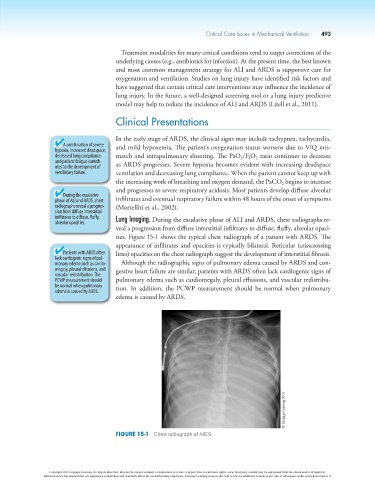
                          infiltrates to diffuse, fluffy,   Lung Imaging. During the exudative phase of ALI and ARDS, chest radiographs re-
                          alveolar opacities.
                                             veal a progression from diffuse interstitial infiltrates to diffuse, fluffy, alveolar opaci-
                                             ties. Figure 15-1 shows the typical chest radiograph of a patient with ARDS. The
                                             appearance of infiltrates and opacities is typically bilateral. Reticular (crisscrossing
                            Patients with ARDS often   lines) opacities on the chest radiograph suggest the development of interstitial fibrosis.
                          lack cardiogenic signs of pul-
                          monary edema such as cardio-  Although the radiographic signs of pulmonary edema caused by ARDS and con-
                          megaly, pleural effusions, and   gestive heart failure are similar, patients with ARDS often lack cardiogenic signs of
                          vascular redistribution. The
                          PCWP measurement should   pulmonary edema such as cardiomegaly, pleural effusions, and vascular redistribu-
                          be normal when pulmonary   tion. In addition, the PCWP measurement should be normal when pulmonary
                          edema is casued by ARDS.
                                             edema is caused by ARDS.


                                                                                                     © Cengage Learning 2014


                                             Figure 15-1  Chest radiograph of ARDS.


                        Copyright 2013 Cengage Learning. All Rights Reserved. May not be copied, scanned, or duplicated, in whole or in part. Due to electronic rights, some third party content may be suppressed from the eBook and/or eChapter(s).
                      Editorial review has deemed that any suppressed content does not materially affect the overall learning experience. Cengage Learning reserves the right to remove additional content at any time if subsequent rights restrictions require it.

