


Page 536 - Clinical Application of Mechanical Ventilation
P. 536
502    Chapter 15


                                            General Principles of HIE


                                            The brain occupies about 2% of the total body weight but uses 15% of the energy
                          Causes of acute cerebral   generated by the body. Unlike the muscle cells in the body, the brain does not
                        hypoxia include inadequate
                        ventilation or oxygenation,   hold or store any energy of its own except for a small amount of glycogen in the
                        inadequate perfusion, and   astrocytes. Furthermore, the brain cells cannot utilize fatty acids because they are
                        decrease in cerebral perfusion
                        pressure.           not transported across the brain capillaries. The brain is highly dependent on the
                                            constant supply of oxygen and glucose provided by the blood. For these reasons, a
                                            severe deprivation of oxygen (e.g., respiratory/cardiac arrest, shock, severe anemia,
                                            decrease in CPP) or lack of glucose (e.g., hypoglycemia, starvation) can severely
                                            affect the normal functions of the brain (Agamanolis, 2011).
                                             A lack of cerebral circulation depletes the neuronal oxygen stores within 20 seconds
                          A lack of cerebral circula-  and leads to unconsciousness. Within 5 minutes of complete cerebral anoxia, brain
                        tion depletes the neuronal
                        oxygen stores within 20   glucose and ATP stores are lost, and energy depletion is the end result (Madl et al.,
                        seconds and leads to uncon-  2004). The mechanism of cerebral cellular injury and death as a result of energy depri-
                        sciousness. Within 5 minutes
                                                                                                             1
                        of complete cerebral anoxia,   vation is complex. The first event following energy depletion is failure of the Na  and
                        brain glucose and ATP stores   1
                        are lost, and energy depletion   K  pumps, leading to depolarization of the neuronal membrane. Depolarization causes
                        is the end result.  neurons to release excessive glutamate into the synaptic cleft. Since some glutamate
                                            receptors are nonselective cation-permeable ion channels, influx of excessive Ca 11  into
                                            neurons leads to activation of catabolic (destructive) enzymes, as well as activation of ni-
                                            tric oxide synthase and increase of nitric oxide production. Furthermore, passive influx
                                                2
                                                        1
                                            of Cl (and Na ) into the cells can cause osmotic edema and rapid death of the cells
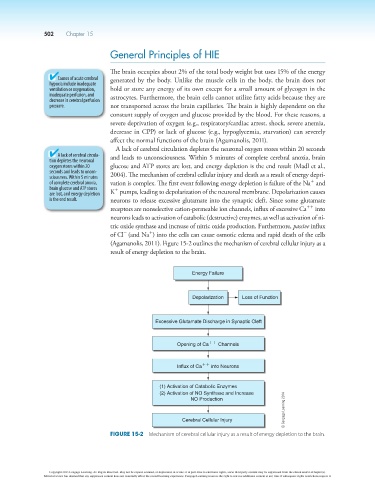
                                            (Agamanolis, 2011). Figure 15-2 outlines the mechanism of cerebral cellular injury as a
                                            result of energy depletion to the brain.


                                                                      Energy Failure


                                                                      Depolarization   Loss of Function


                                                          Excessive Glutamate Discharge in Synaptic Cleft


                                                                 Opening of Ca 11  Channels


                                                                 Influx of Ca 11  into Neurons


                                                            (1) Activation of Catabolic Enzymes
                                                            (2) Activation of NO Synthase and Increase
                                                                                                    © Cengage Learning 2014
                                                                      NO Production

                                                                   Cerebral Cellular Injury

                                            Figure 15-2  Mechanism of cerebral cellular injury as a result of energy depletion to the brain.


                        Copyright 2013 Cengage Learning. All Rights Reserved. May not be copied, scanned, or duplicated, in whole or in part. Due to electronic rights, some third party content may be suppressed from the eBook and/or eChapter(s).
                      Editorial review has deemed that any suppressed content does not materially affect the overall learning experience. Cengage Learning reserves the right to remove additional content at any time if subsequent rights restrictions require it.

